


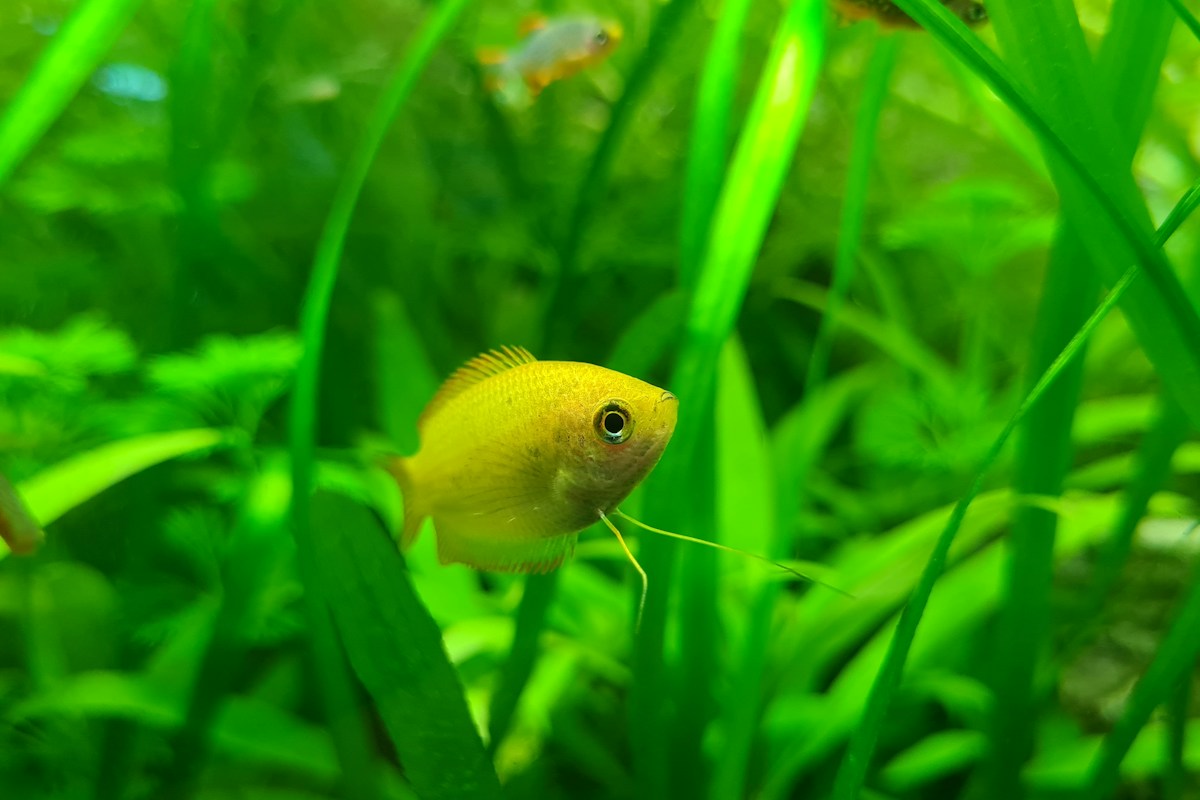
In the realm of peaceful, small-footprint community aquariums, finding a captivating centerpiece fish that combines striking coloration, curious personality, and absolute tranquility is a perennial challenge. While the Dwarf Gourami (*Trichogaster lalius*) is frequently recommended to beginners, it has unfortunately become plagued by systemic commercial health crises, including extreme inter-species aggression and the fatal, incurable Dwarf Gourami Iridovirus (DGIV). Rising majestically above these vulnerabilities stands the *Honey Gourami* (*Trichogaster chuna*, formerly *Colisa chuna*).
Native to the tranquil, heavily vegetated river basins, lakes, and rice fields of India and Bangladesh, the Honey Gourami represents the zenith of peaceful anabantoid husbandry. Reaching an adult size of just 1.8 to 2.0 inches (4.5 to 5.0 cm), this gentle jewel is remarkably peaceful, interacting with community tankmates without the territorial malice common among other gourami species.
Honey Gouramis possess extraordinary physiological adaptations, most notably the auxiliary suprabranchial labyrinth organ that enables them to extract oxygen directly from atmospheric air, and highly modified thread-like pelvic fins that function as tactile sensory ‘feelers’ used to touch and explore their environment. In breeding condition, males undergo an astonishing chromatic transformation, trading soft honey-gold tones for a blazing sunset-orange flank, a shimmering neon-turquoise dorsal stripe, and a velvet-black throat shield.
Cultivating thriving Honey Gouramis requires an intimate understanding of labyrinth organ gas exchange, surface current moderation, floating plant architecture, and delicate bubble nest courtship biology.
Anabantoid Physiology: The Labyrinth Organ Mandate
The defining physiological hallmark of *Trichogaster chuna* is the labyrinth organ, an intricate, highly vascularized bony suprabranchial structure located above the gills. Evolving in warm, stagnant, oxygen-depleted backwaters prone to seasonal drought, anabantoids utilize this auxiliary organ to breathe atmospheric oxygen directly from the water surface.
While the labyrinth organ grants incredible survival resilience in low-oxygen waters, it introduces a unique environmental vulnerability that many aquarists overlook. Honey Gouramis must breathe the air layer situated immediately above the water surface. If the ambient air in the room is significantly colder or drier than the aquarium water, the sudden inhalation of cold air into the vascularized labyrinth chamber induces acute thermal inflammation, pneumonia-like symptoms, and organ failure.
To protect this delicate organ, aquariums housing Honey Gouramis must always feature a tight-fitting canopy or glass lid. The enclosed lid traps warm, humid air above the water column, ensuring that every atmospheric breath taken by the fish matches the water temperature precisely.
Tactile Sensory Pelvic Fins: Underwater Feelers
One of the most endearing behaviors of the Honey Gourami is the continuous, inquisitive movement of their modified pelvic fins. Reduced to slender, flexible filaments packed with dense taste buds and tactile nerve endings, these feelers are actively deployed to explore new decorations, touch plant stems, and greet conspecifics.
Aquarists must ensure that tankmates do not include notorious fin-nipping species (such as Tiger Barbs, Serpae Tetras, or aggressive fin-targeting danios) that mistake these delicate feelers for tasty aquatic worms. An injured or severed feeler causes immense stress, although it can slowly regenerate under clean, pristine water conditions.
Water Dynamics and Floating Botanical Architecture
Honey Gouramis are adapted to placid, virtually still waters. Strong hydraulic currents generated by oversized canister filter outflows, internal circulation powerheads, or violent bubbling air stones overwhelm their delicate physical endurance, forcing them to expend excessive metabolic energy merely holding position.
Filtration should deliver thorough biological turnover while minimizing surface turbulence. Air-driven sponge filters or canister filters equipped with broad spray bars directed against the aquarium glass create gentle, circular currents ideal for anabantoids.
Furthermore, floating vegetation is mandatory for their psychological well-being. Species such as Amazon Frogbit (*Limnobium laevigatum*), Red Root Floaters (*Phyllanthus fluitans*), and Water Lettuce (*Pistia stratiotes*) provide a suspended root sanctuary where gouramis forage for micro-invertebrates and seek shade. In tanks lacking floating cover, Honey Gouramis remain nervous, hovering near the substrate with washed-out coloration.
Courtship Dynamics and Bubble Nesting Mechanics
During the breeding cycle, the male Honey Gourami constructs an architectural marvel known as a bubble nest. Selecting a quiet, sheltered corner among floating plant leaves, the male gulps surface air, coats each bubble in specialized oral mucus, and anchors the buoyant bubbles beneath the underside of a leaf.
As the nest expands, the male undergoes his breathtaking chromatic transformation. His soft golden body darkens into an intense, fiery honey-orange, while his throat, chest, and anal fin flush a deep, velvety jet-black, crowned by an electric-blue dorsal fin margin. Courting a plump, silvery-bronze female with rhythmic fluttering displays, the male coaxes her beneath the bubble nest.
In a tender spawning embrace, the pair rolls beneath the nest as the female releases buoyant, transparent eggs that float directly into the mucus bubbles. Once spawning concludes, the devoted male assumes full parental custody, guarding the nest vigorously against intruders, repairing popped bubbles, and gently retrieving any fallen fry until they become free-swimming 48 to 72 hours later.
Community Compatibility: The Gentle Centerpiece
Unlike aggressive three-spot gouramis (*Trichopodus trichopterus*) or territorial male Betta splendens, Honey Gouramis can be safely housed in male-female pairs or small groups (such as one male and two females) in tanks 20 gallons or larger without violent territorial battles.
Their peaceful disposition makes them the ultimate centerpiece fish for nano and community biotopes housing peaceful schooling fish (Harlequin Rasboras, Neon Tetras, Ember Tetras), gentle bottom-dwellers (Corydoras catfish, Kuhli loaches), and adult dwarf freshwater shrimp (Amano and Neocaridina). They ignore non-aggressive tankmates, adding vibrant golden focal points to the upper water column.
Providing the ideal biological parameters ensures vibrant coloration, peaceful community dynamics, and bubble nest breeding in Honey Gouramis. Review the husbandry matrix below.
Honey Gourami (Trichogaster chuna) Care Matrix
| Husbandry Factor | Target Standard | Physiological / Ecological Role | Hazardous Configurations |
|---|---|---|---|
| Surface Air Layer | Warm, humid air under tight lid | Protects vascularized labyrinth organ | Cold drafty room air causes organ shock |
| Water Flow Dynamics | Gentle / Minimal Surface Agitation | Preserves floating bubble nests; prevents fatigue | Violent surface currents destroy nests |
| Floating Vegetation | Frogbit, Salvinia, Red Root Floaters | Provides shade, shelter, and nest anchors | Bare unshaded surfaces trigger severe stress |
| Water Parameters | pH 6.5 – 7.5 | GH 4 – 12 dGH | 74°-82°F | Replicates Indian and Bengali river plains | Extreme cold water (<72°F) induces lethargy |
| Compatible Tankmates | Peaceful tetras, rasboras, Corydoras | Gentle community harmony | Fin nippers (Tiger Barbs) chew feeler fins |
Following these specialized guidelines ensures vibrant health and fascinating courtship displays. Review the essential operational inquiries below.
Frequently Asked Questions About Honey Gourami Care
How do you tell Honey Gouramis apart from Dwarf Gouramis?
Honey Gouramis (*Trichogaster chuna*) are smaller (under 2 inches), have slender bodies, and lack the electric-blue vertical stripes of Dwarf Gouramis (*Trichogaster lalius*). Honey Gouramis are also vastly more peaceful and completely resistant to Dwarf Gourami Iridovirus.
Can you keep multiple Honey Gouramis together in the same tank?
Yes. Honey Gouramis are peaceful and can be kept in male-female pairs, trios (one male and two females), or small groups in tanks of 20 gallons or larger with ample floating plants.
What do Honey Gouramis eat?
They are omnivores that thrive on high-quality micro-pellets, spirulina flakes, and frozen or live foods such as baby brine shrimp, daphnia, and bloodworms.
Why do Honey Gouramis use their thread-like pelvic fins to touch things?
Their pelvic fins have evolved into delicate sensory feelers loaded with taste buds and tactile nerve endings. They use them to feel plants, explore decor, and communicate with other gouramis.
Do Honey Gouramis need a heater and an aquarium lid?
Yes, both are essential. They need warm tropical water (75 to 80 degrees Fahrenheit) and a tight-fitting lid to keep the air layer above the water warm and humid, protecting their labyrinth breathing organ.
How can you tell a male Honey Gourami from a female?
Breeding males develop a vibrant fiery honey-orange body with a distinctive black throat and chest and bright yellow-edged dorsal fin. Females are slightly plumper and remain a uniform soft silvery-tan or pale gold with a faint horizontal stripe.
Are Honey Gouramis safe with freshwater dwarf shrimp?
Yes, Honey Gouramis are among the safest centerpiece fish for shrimp tanks. Adult Neocaridina and Amano shrimp are completely ignored, though tiny newly hatched shrimplets may occasionally be eaten if not hidden in moss.
What is the minimum aquarium size for a pair of Honey Gouramis?
A 10-gallon tank can support a single Honey Gourami, but a 15 to 20-gallon planted tank is strongly recommended for a pair or trio to provide adequate swimming space and plant cover.
Why is my male Honey Gourami blowing bubbles at the surface?
This is a natural courtship behavior known as bubble nesting. The male gulps air, coats bubbles in saliva, and builds a floating raft among plant leaves to house and fertilize eggs.
Strategic Conclusion and Anabantoid Stewardship
The Honey Gourami stands as the premier centerpiece choice for peaceful freshwater community aquariums. Combining breathtaking nuptial coloration, peaceful social interactions, and fascinating labyrinth organ biology, *Trichogaster chuna* brings enduring joy without the behavioral aggression or viral fragilities seen in other species. Providing still, warm water, abundant floating plant canopies, and a protected humid air layer ensures a thriving, long-lived jewel in your home aquatic sanctuary.
For more scientific data on anabantoid evolution and taxonomy, consult peer-reviewed entries at the FishBase Information System, international aquatic husbandry standards from the Food and Agriculture Organization, and plant biotope recommendations at the Aquatic Gardeners Association.