


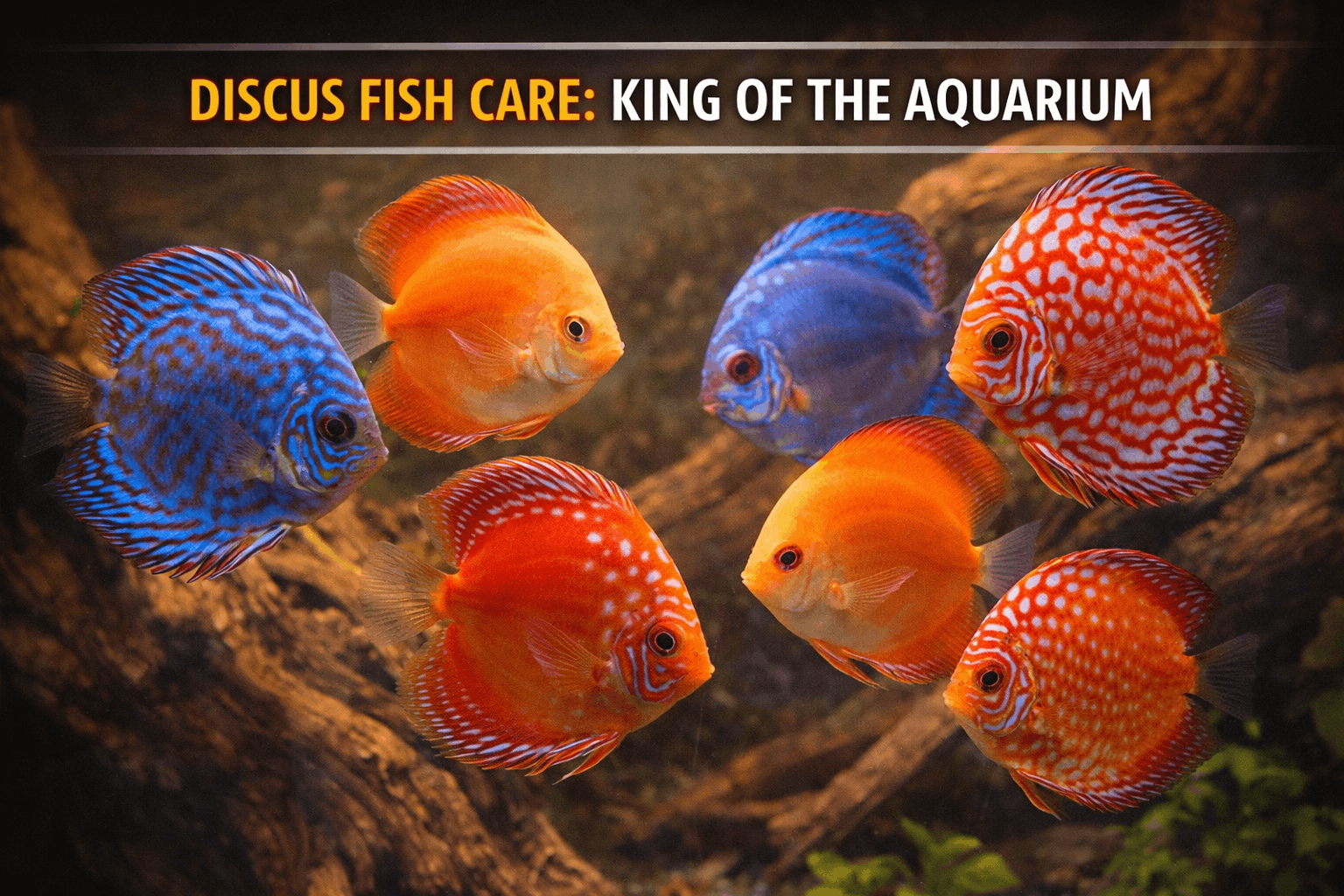
Meeting the King of the Aquarium
Still remember the first time I saw a Discus fish , I was walking through a fish gallery, and I saw a tank filled with fish that looked like giant, colorful dinner plates. They were bright blue, deep red, and shimmering orange. I had never seen anything like it.
Many people call the Discus the “King of the Aquarium.” They are famous for being the most beautiful freshwater fish, but they are also famous for being “difficult.” For a long time, I was scared to try keeping them. I had heard stories that they would get sick if the water wasn’t perfect.
But here is the truth I’ve learned: Discus are not “impossible.” They just have very specific rules. If you follow my rules, you can keep these kings in your own home. In this 1,500-word guide, I’m going to break down the science of Discus care into simple, easy steps that anyone can follow.
Step 1: What Makes a Discus Different?
Before you buy a Discus, you need to understand where they come from. They live in the Amazon River in South America. The water there is very warm, very soft, and very clean.
The Shape and Color:
Discus are named for their shape—they are round and flat like a disc. This shape allows them to hide between tree roots and tall plants in the river. They come in hundreds of colors, which we call “strains.” You might see names like “Pigeon Blood,” “Blue Diamond,” or “Marlboro Red.”
The “Expert” Secret:
The most important thing to know about Discus is that they are sensitive. Unlike a Guppy or a Betta, they cannot handle “dirty” water. If you skip a water change, they will tell you immediately by turning dark in color or hiding. They are the ultimate “test” of your skills as a fish keeper.
Step 2: The Perfect Home (Tank Size and Setup)
I often see beginners try to put a Discus in a small 10-gallon tank. I want to tell you right now: Please do not do this.
1. The Tank Size A Discus can grow to be 6 or 8 inches long. Because they are big and they like to live in groups, you need space.
-
Recommendation: A 55-gallon tank as the absolute minimum. If you can get a 75-gallon tank, your fish will be much happier and grow much faster.
2. The Temperature (It’s Hot!) This is the part that surprises most of my students. Most tropical fish like water at 78°F. Discus like it much hotter. * The Rule: You must keep your tank between 82°F and 86°F.

-
Why? Their bodies work faster in warm water. It keeps their immune system strong and helps them digest their food. You will need a very good, reliable heater for a Discus tank.
3. To Substrate or Not to Substrate? In the professional world, there is a big debate. Many experts keep Discus in “Bare Bottom” tanks (no sand or gravel).
-
Why? Because Discus eat messy food. Without gravel, it is very easy to suck up the extra food so the water stays perfectly clean.
-
My Advice for You: If you want a beautiful tank in your room, use a very thin layer of Fine White Sand. It looks natural but is still easy to keep clean.
Step 3: The Water Chemistry (The “Clean” Rule)
If you want to be successful with the King of the Aquarium, you have to become a “Water Scientist.”
Soft and Acidic Water: In the Amazon, the water is “soft” (very few minerals) and “acidic” (low pH).
-
The Goal: Try to keep my pH between 6.0 and 7.0.
-
How to do it: Many Discus keepers use an “RO Filter” (Reverse Osmosis) to make pure water. If you are a student on a budget, you can use driftwood and peat moss to naturally lower your pH.
The Water Change Schedule: This is the most important part of this entire guide. You cannot keep Discus and only change the water once a month.
-
Routine: Change 25% to 50% of the water every single week. Some professional breeders change the water every day! Clean water is the “secret medicine” that keeps Discus alive. If you provide clean water, 90% of your problems will disappear.
Step 4: Social Life (The Power of the School)
I sometimes see people buy just one Discus because they are expensive. This is a mistake that leads to a very sad fish.
The Group Rule: Discus are “Cichlids,” and they are very social. They have a “Pecking Order,” which means they have a boss and a hierarchy.
-
Recommendation: You should have a group of at least 6 Discus.
-
Why? If you only have two, the stronger one will bully the weaker one until it stops eating. In a group of six, the “boss” fish spreads the attention around, and everyone stays safe and happy.
Watching Their Language: I love watching Discus interact. They talk to each other through their colors. If a Discus is happy, its colors will be bright. If it is angry or scared, it might show “Stress Bars” (dark vertical lines on its body). Learning to read these bars is how you become an expert.
Step 5: The Discus Diet (High Protein)
Discus are like athletes; they need high-quality fuel to grow those big, round bodies. You cannot just give them cheap fish flakes.

The Menu:
-
Beef Heart: This is the “gold standard” for Discus. It is high in protein and helps them grow huge. You can buy it frozen at the pet store.
-
Bloodworms: These are a favorite treat. My Discus go crazy whenever they see the frozen cube hit the water!
-
Special Pellets: There are many “Discus Bits” made specifically for their small mouths.
The Feeding Habit: Discus are “grazers.” They like to blow at the sand to find food. Because they are in warm water, they have high metabolisms. I feed my young Discus 3 times a day. For adults, twice a day is perfect.
Step 6: Choosing Tank Mates
Because Discus live in very hot water (84°F+), many “normal” fish cannot live with them. They would literally cook! You have to pick fish that also love the heat.
Good Roommates:
-
Cardinal Tetras: These look like Neon Tetras but handle the heat better. A school of 20 Cardinals with 6 Discus is the most beautiful tank in the hobby.
-
Sterba’s Corydoras: These are the only “Catfish” that I trust in a hot Discus tank. They stay at the bottom and clean up the extra beef heart.
-
Rummy Nose Tetras: These are great because their red faces turn pale if the water quality is bad. They are like a “living alarm system” for your Discus!
Fish to Avoid:
-
Angelfish: Many people keep them together, but Angelfish are much faster and more aggressive. They often steal all the food before the shy Discus can get a bite.
-
Plecos (Algae Eaters): Some large Plecos will actually try to “latch on” to the side of the flat Discus and eat their slime coat. It is very dangerous, so be careful which ones you pick!
The “Expensive” Lesson
When I was first starting out, I bought four beautiful Discus. I was so proud! But I was lazy with my water changes. I thought, “The water looks clear, it should be fine for another week.”
What happened: Within two weeks, my fish stopped eating. They hid in the back corner and their beautiful colors turned dark gray. I realized I had “Nitrate buildup.” I had to do 50% water changes every day for a week to save them. It was a lot of work, and it taught me that the King does not tolerate a dirty palace. Now, I never skip a water change day. It is my “Zen time,” and it keeps my fish looking like royalty.
3 Tips for Buying Your First Discus
-
Buy “Local”: Try to find a breeder in your city. Fish that are born in your local tap water are much tougher than fish that were flown across the ocean.
-
Check the Eyes: A healthy Discus has a small, bright eye. If the eye looks “huge” compared to the body, it means the fish is “stunted” (it didn’t grow properly because of bad water or food).
-
Watch them Eat: Before you give the store your money, ask them to feed the fish. If the Discus doesn’t rush toward the food, don’t buy it! A healthy Discus is always a hungry Discus.
Conclusion: Is the King Right for You?
Keeping Discus is the “Black Belt” of the freshwater hobby. It requires more work, more water changes, and a bit more money for high-quality food. But I can tell you from my heart: it is worth it. There is nothing more rewarding than sitting in a dark room at night and watching a school of colorful Discus glide through the water. It is like having a living piece of the Amazon rainforest in your bedroom.
If you are a student or a beginner, don’t be afraid. Start with a 55-gallon tank, get a good heater, and commit to your weekly water changes. If you respect the King, the King will reward you with beauty that no other fish can match.
Do you have a dream Discus tank in mind? Or are you worried about your water pH? Leave a comment below! I love helping new Discus keepers succeed, and I’m here to answer all your technical questions.