


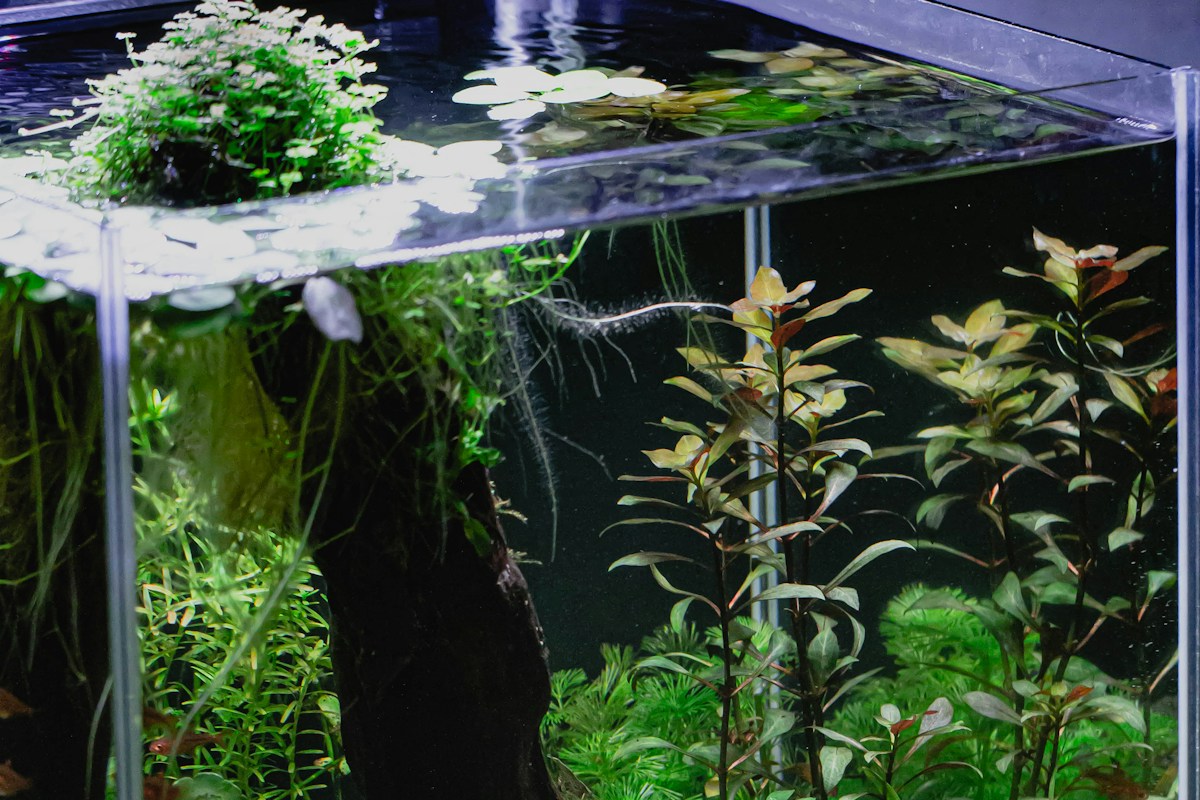
Long before modern Japanese Nature Aquariums popularized driftwood root tangles and minimalist stone Iwagumi layouts, European hobbyists in the Netherlands cultivated a disciplined, botanical art form that remains the undisputed masterclass of aquatic plant horticulture: the Dutch Style Aquascape. Originating in the 1930s under the auspices of the Dutch Society for Aquaristics (NBAT), this living mosaic transforms an aquarium into an opulent underwater botanical garden, celebrated for vibrant floral contrast, geometric precision, and impeccable plant health.
Unlike contemporary styles that lean heavily on inert hardscape – such as Seiryu stones and spider wood branches – traditional Dutch aquascaping strictly minimizes or entirely forbids visible wood and rock. The aesthetic narrative is communicated exclusively through living aquatic macrophytes. Every square centimeter of the layout is strategically orchestrated to showcase deliberate height gradients, color theory, leaf texture contrasts, and clean optical pathways.
Achieving and sustaining a competition-grade Dutch aquarium requires far more than casual green-thumb gardening. It demands an uncompromising mastery of aquatic agronomy: balancing high-intensity PAR illumination, continuous pressurized carbon dioxide saturation, specialized macro- and micro-nutrient fertilizer schedules, and rigorous weekly pruning techniques.
This design blueprint provides the authentic NBAT compositional rules, plant selection matrices, street-planting perspective geometries, and horticultural protocols necessary to build a breathtaking Dutch underwater masterpiece.
The NBAT Golden Rules: Compositional Geometry and Restraint
The Dutch Society for Aquaristics (*Nederlandse Bond Aqua Terra*) codifies strict design regulations to ensure visual harmony and prevent chaotic, overcrowded plant collections.
The foundational rule governs botanical diversity: an authentic Dutch aquascape should maintain no more than one plant species per 10 centimeters (4 inches) of tank length, and never exceed 12 to 15 distinct species in a standard 4-foot display. Packing thirty random stem plant species into a tank violates Dutch principles, devolving the composition into an unfocused plant nursery.
Furthermore, species groupings must be separated by distinct physical boundaries: adjacent plant groups must never touch or intertwine. Each group forms a self-contained, sculpted bush or hedge, creating crisp visual definition across the substrate bed.
According to design principles recognized by the Aquatic Gardeners Association, the Golden Ratio (1:1.618) dictates the positioning of focal groups. Placing red or structurally dominant plants at traditional focal points – roughly two-thirds across the tank width – anchors the viewer gaze, while contrasting green groups fan outward to frame the composition.
The Art of the Dutch Plant Street (Leidse Straat)
The most iconic hallmark of a Dutch aquascape is the plant street, traditionally termed the *Leidse Straat* (Leiden Street). This technique creates profound forced optical depth within a narrow glass vessel.
A plant street begins in the foreground viewing plane and extends diagonally toward the rear focal corner. The street is planted using low, uniform species – classically *Lobelia cardinalis* ‘Mini’, *Staurogyne repens*, or *Pogostemon helferi*. Crucially, the street must not be a straight, uniform line; it must curve gently like an authentic cobblestone road, starting broad and low in the front and narrowing as it ascends toward the rear.
As the street travels backward, each successive plant node is pruned slightly taller than the one before it. This upward slope, combined with lateral narrowing, exploits perspective vanishing points, tricking the human eye into perceiving infinite optical depth in a tank that measures only 18 to 24 inches from front to back.
Color Theory and Leaf Texture Contrast Principles
In a hardscape-free aquarium, visual energy relies entirely on contrasting juxtaposition. Placing two broad-leaved green species adjacent to each other produces visual stagnation and muddy composition.
Dutch masters utilize three axes of contrast: Color, Leaf Shape, and Growth Form.
Color Contrast: A bright green hedge (such as *Bacopa caroliniana*) is bordered immediately by a deep wine-red or purple species (such as *Ludwigia glandulosa*, *Alternanthera reineckii*, or *Rotala macrandra*), which is in turn bordered by a pale olive or chartreuse grouping (*Limnophila aromatica*).
Texture Contrast: Fine, needle-like foliage (*Pogostemon stellatus* or *Myriophyllum*) is set against massive, broad ovate leaves (*Echinodorus* or *Samolus*), while delicate ribbon-like leaves (*Vallisneria nana* or *Cryptocoryne spiralis*) frame the rear corners.
Horticultural Engineering: Trimming Topography and Nutrient Demands
Sustaining sculpted Dutch hedges requires high-tech horticultural support. Maintaining rapid growth and intense carotenoid pigmentation demands high photosynthetic active radiation (PAR 80 to 120 micromoles per square meter per second at the substrate) paired with stable, pressurized $ injection maintained at 30 to 35 ppm.
Nutrient dosing must follow complete saturation regimes, such as the Estimating Index (EI) methodology, delivering abundant nitrate (^-$ 15 to 25 ppm), phosphate (^{3-}$ 1.5 to 3.0 ppm), potassium (^+$ 15 to 20 ppm), and chelated iron/trace elements. Because Dutch tanks possess immense vegetative biomass, nutrient depletion occurs rapidly; under-dosing stalls photosynthesis and triggers lower-leaf yellowing.
Pruning is the ultimate architectural tool. To maintain dense, bushy hedges rather than leggy stems, stems are trimmed progressively. Instead of uprooting and replanting tops weekly, the aquarist shears the upper canopy down by two to three inches just above nodal internodes. This ‘topping’ induces lateral branching, doubling the number of shoots and creating an impenetrable, velvet-like hedge.
Designing a Dutch aquascape requires deliberate plant selection based on color, leaf morphology, and placement tier. Review the Dutch botanical architecture matrix below.
Dutch Aquascaping Botanical Architecture Matrix
| Plant Species | Zonal Placement | Chromatic Tone | Leaf Morphology | Architectural Function |
|---|---|---|---|---|
| Lobelia cardinalis ‘Mini’ | Foreground to Midground | Vibrant Lime Green | Dense, rounded oval leaves | Classic Dutch Plant Street (Leidse Straat) |
| Alternanthera reineckii ‘Mini’ | Midground Focal Corner | Deep Ruby / Magenta | Lanceolate opposite leaves | Golden Ratio chromatic anchor |
| Pogostemon helferi | Foreground Border | Bright Emerald Green | Curly, crinkled star rosettes | Textural contrast against smooth stems |
| Rotala macrandra | Background Center-Right | Fiery Carmine Red | Broad, undulating delicate leaves | High-light red background focal hedge |
| Limnophila aquatica | Background Rear Corner | Pale Feathery Green | Finely dissected whorled umbrellas | Massive feathery texture screen |
Mastering these botanical pairings ensures geometric perfection and competition-ready contrast. Review the essential care inquiries below.
Frequently Asked Questions About Dutch Style Aquascaping
Can you use driftwood or rocks in a true Dutch aquascape?
Traditional NBAT rules strictly discourage or forbid visible hardscape. The entire aesthetic narrative must be communicated through living plants; small anchor stones are allowed only if completely concealed by moss.
What is a Leidse Straat (Plant Street)?
A plant street is a diagonal path of low-growing plants that starts wide and low in the front and curves backward, narrowing and rising in height to create dramatic forced perspective and optical depth.
How many plant species should be in a Dutch aquarium?
NBAT guidelines recommend approximately one species per 10 cm (4 inches) of tank length, and no more than 12 to 15 species in a standard 4-foot aquarium. Overcrowding ruins the clean visual structure.
How do you prune stem plants to create dense Dutch hedges?
Rather than uprooting stems, trim the upper tops with curved aquascaping scissors just above a leaf node. The severed stems will produce multiple lateral side shoots, creating a thick, bushy hedge.
Is pressurized CO2 mandatory for a Dutch aquascape?
Yes. Dense stem plant biomass and demanding red species (*Rotala macrandra*, *Ludwigia glandulosa*) require stable 30 ppm dissolved CO2 and high PAR lighting to sustain rapid growth and intense coloration.
Why do Dutch aquascapes avoid carpeting plants across the whole foreground?
Traditional Dutch style emphasizes clean substrate pathways, distinct plant streets, and contrasting terraced groups rather than a uniform, monoculture lawn of Monte Carlo or dwarf hairgrass.
What fertilizer regimen is best for a Dutch aquascape?
The Estimating Index (EI) dosing method is ideal. It delivers non-limiting macronutrients and micronutrients daily, followed by a 50 percent weekly water change to reset nutrient levels and prevent accumulation.
How do you prevent adjacent plant groups from mixing together?
Regular weekly pruning creates distinct physical air gaps between hedges. Leaving 1 to 2 inches of open space between species groups prevents stems from tangling and maintains crisp geometric lines.
What background should be used on a Dutch tank?
A plain matte black or dark blue background is standard. It provides an unyielding, high-contrast backdrop that makes the vibrant greens, golds, and reds of the plant hedges stand out brilliantly.
Strategic Conclusion and Botanical Garden Mastery
The Dutch Style Aquascape is a celebration of living architecture, where horticultural discipline and aesthetic restraint unite to create breathtaking underwater art. By eschewing the crutch of towering hardscape and committing entirely to the color palettes, textures, and growth habits of aquatic macrophytes, the aquarist achieves the ultimate expression of botanical harmony. Cultivating a thriving Dutch scape is a daily testament to the profound beauty of scientific plant cultivation.
For more design standards and historical competition archives, explore publications from the Aquatic Gardeners Association, botanical physiology references at the University of Florida IFAS Agronomy Extension, and international aquatic flora records at the Food and Agriculture Organization.