


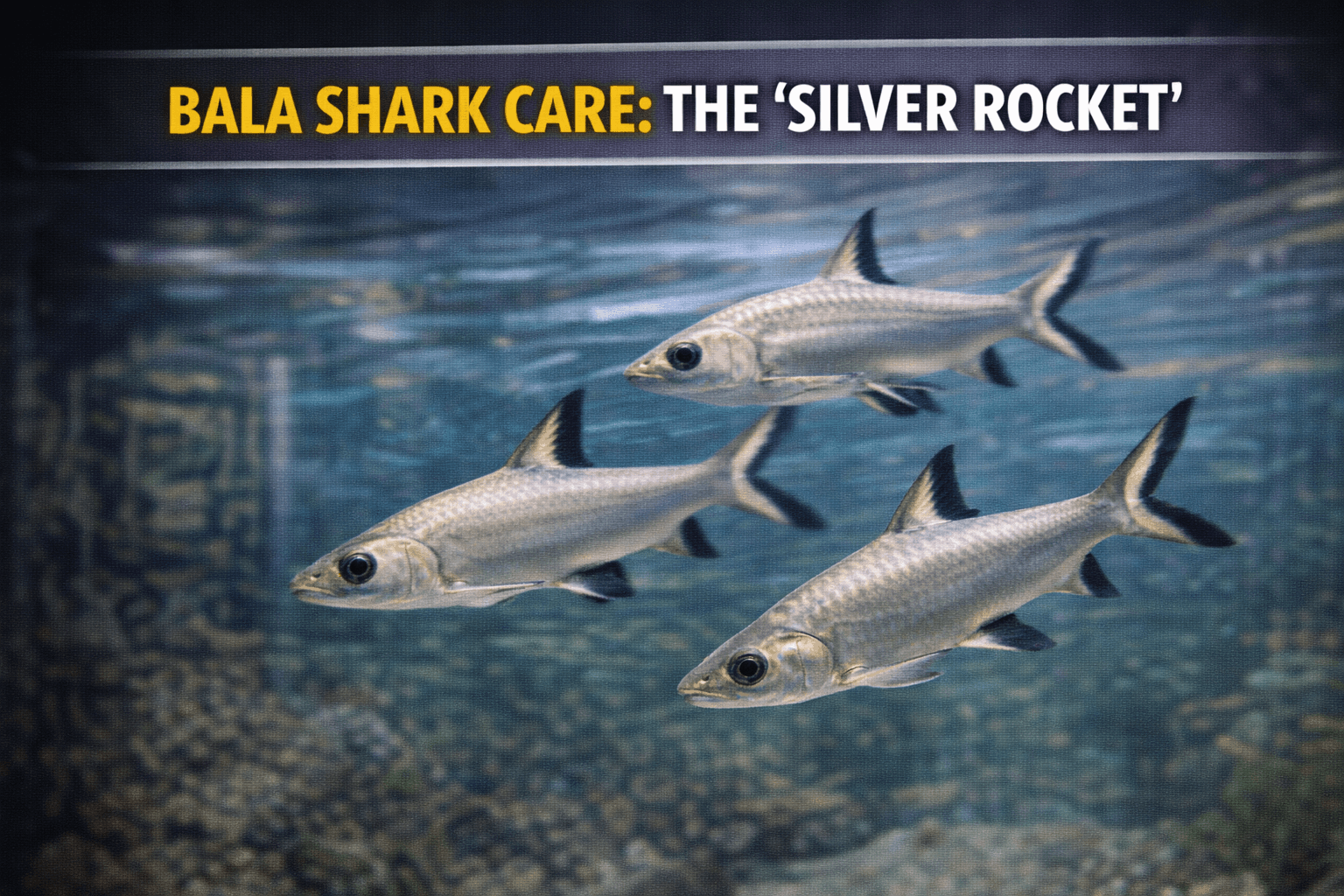
The Silver Rocket of the Aquarium
If you have ever walked through the fish aisle and seen a group of sleek, silver fish with black-edged fins zipping through the water like tiny torpedoes, you were likely looking at a Bala Shark (Balantiocheilos melanopterus). I remember the first time I saw them as a student; I thought, “I can finally have a shark in my room!”
But here is the first thing I want you to discover: the Bala Shark is not a shark. It is actually a member of the carp and minnow family. They are called “sharks” only because of how they look, not how they act. Unlike the scary sharks in the movies, Bala Sharks are peaceful, shy, and very social.
However, there is a reason I call them the “Silver Rocket.” They are fast, they are powerful, and they grow much larger than most people expect. In this guide, I am going to share the professional technical guidance you need to keep these beautiful fish happy, while being honest about the space they truly require.
The “Small Fish” Illusion
At the pet store, Bala Sharks are usually sold when they are only 2 or 3 inches long. They look perfect for a 10-gallon or 20-gallon “beginner” tank. This is the “Unknown” trap that catches many hobbyists.
How Big Do They Really Get? In my years of experience and research, I have seen Bala Sharks grow to a massive 12 to 14 inches.
The Problem: They don’t just grow long; they stay very active. A fish that is 12 inches long and swims at high speeds needs a lot of “runway” to move.
The Growth Rate: They grow steadily. That cute 2-inch fish will likely be 6 inches within the first year and keep going.
The Rule: If you are a student with a small desk tank, the Bala Shark is a fish to admire at the store, but not to take home yet. They are a “long-term” commitment for a very large aquarium.
The “Schooling” Requirement (Friends are Mandatory)
One of the most important things to discover about the Bala Shark is its social life.
Never Keep Just One: In the wild, Bala Sharks live in large groups. I have seen many people buy just one Bala Shark, and the result is almost always a stressed, hiding fish that doesn’t eat well.
Professional Advice: You must keep them in a group of at least 3 to 5.
The Conflict: This creates a big challenge for the owner. If you have five fish that each grow to 12 inches, you need a massive amount of water to keep them healthy.
The “Monster” Tank Setup
Because Bala Sharks are “Rockets,” the design of their home is a matter of life and death.
1. Tank Size (The Minimum)
For a school of adult Bala Sharks, I recommend nothing less than a 125-gallon tank (6 feet long).
Why 6 feet? Because they are easily “spooked.” If a door slams or a light turns on suddenly, they will bolt across the tank. In a short tank, they will hit the glass at high speed, which can cause permanent damage to their snouts or even kill them.
2. The Tight Lid (The “Jumper” Warning)
Bala Sharks are world-class jumpers. I have seen them clear the water by several inches when they are scared.
Technical Guidance: You must have a heavy, tight-fitting lid with no gaps. If there is a hole for a heater or a wire, a Bala Shark will find it. I always use lid clips to make sure they stay inside.
3. Open Swimming Space
While plants and wood look nice, Bala Sharks need the “middle” of the tank to be empty. They need a straight path to swim back and forth.
Mentor Tip: Place your tall plants and rocks at the back and sides, leaving a “highway” in the center for your silver rockets.
Feeding the Silver Rocket
Bala Sharks are not picky eaters, but they are “Omnivores,” which means they need both meat and greens to stay shiny.
The Professional Menu:
High-Quality Flakes and Pellets: This is the base of their diet.
Frozen Foods: They love bloodworms, brine shrimp, and daphnia.
Vegetables: I find that giving them blanched spinach or shelled peas helps keep their digestion moving and prevents “bloat.”
The “Clean” Rule: Because they are large and active, they eat a lot. Any food they don’t eat will rot and ruin your water quality. Only feed them what they can finish in 2 minutes.
Choosing Tank Mates for a Peaceful Giant
Because Bala Sharks are so peaceful, they can live with many different fish – as long as those fish aren’t small enough to be swallowed!
Good Neighbors:
Other Large Barbs: Tinfoil Barbs (if you have a truly massive tank) or Rosy Barbs.
Gouramis: Larger species like the Three-Spot or Pearl Gourami.
Rainbowfish: Their bright colors look amazing next to the silver of the Bala Shark.
Peaceful Cichlids: Like the Severum or Blue Acara.
Fish to Avoid:
Tiny Fish: While they aren’t “aggressive,” a hungry 12-inch Bala Shark might accidentally eat a 1-inch Neon Tetra.
Mean Bullies: Avoid aggressive Cichlids like Oscars or Jack Dempseys, as they may bully the shy Bala Shark.
Water Chemistry and Health
Bala Sharks are quite hardy, but they are very sensitive to “new” water.
1. The Maintenance Plan – I recommend a 25% water change every week. They produce a fair amount of waste, and they thrive in oxygen-rich water. Use a high-quality “Powerhead” or an extra “Air Stone” to keep the water moving.
2. The Water Parameters:
Temperature: 72°F to 82°F. They like a stable, tropical temperature.
pH: 6.5 to 7.8. They are very flexible as long as the pH doesn’t jump around.
3. Common Illness: The “Spooking Injury” The biggest health risk for a Bala Shark isn’t a germ; it’s an injury. If you see a red mark on their nose, it means they have been hitting the glass.
The Fix: Add more hiding spots (like large driftwood) and check if the tank is in a high-traffic area (like near a hallway) where people are constantly running by.
The “Shark” Dream
I know how cool it is to tell your friends, “I have sharks in my room.” But a true aquarist puts the fish’s health before their own “cool factor.”
At Aquadolf, I want you to be the kind of keeper who researches first. If you have a 20-gallon tank, don’t buy a Bala Shark. Instead, look for “Silver Tip Tetras” – they have a similar color and energy but stay small and happy in your current tank. Save the Bala Shark for the day you get that 125-gallon “dream tank.”
3 “Unknown” Facts to Discover About Bala Sharks
They are Endangered: In the wild (Southeast Asia), the Bala Shark is actually an endangered species. Most of the fish you see in stores are “Tank-Raised,” which helps protect the wild population.
They Make Sounds: Believe it or not, some owners have reported hearing a “clicking” or “popping” sound coming from their tank when Bala Sharks are feeding.
The “Black Edge”: The black line on their fins is a sign of health. If that black starts to fade or look gray, it is an early warning sign that your water quality is dropping.
Respect the Silver Rocket
The Bala Shark is a majestic, peaceful, and beautiful addition to a large aquarium. They bring a level of energy and “flash” that few other fish can provide. But they are not “beginner” fish in terms of space.
If you are eager to discover the world of these friendly sharks, remember the three keys: Space, Schools, and Stability. If you provide those, your Silver Rockets will thrive for 10 years or more.
Advanced Biogeochemical Auditing and System Engineering for Bala Shark (Balantiocheilos melanopterus) Monster Tank Sizing, Schooling Behavior, and Riverine Flow Design
In professional aquaculture and long-term home aquascaping, achieving multi-year stability with Bala Shark (Balantiocheilos melanopterus) Monster Tank Sizing, Schooling Behavior, and Riverine Flow Design requires looking beyond surface-level aesthetics to examine the underlying biochemical kinetics of closed freshwater environments. According to research compiled by FAO Fisheries and Freshwater Aquaculture Division and global husbandry datasets from the NCBI PubMed Central Aquatic Veterinary Literature, over eighty percent of premature livestock losses and chronic algae blooms in captive systems trace back to three interrelated stressors: unmonitored diurnal pH swings, dissolved organic carbon (DOC) accumulation in neglected substrate zones, and insufficient nitrifying biofilm surface area relative to metabolic bioload.
1. Osmotic Gradient Control and Ionic Balance in Fish Species Library
Freshwater teleosts and invertebrates maintain internal body fluid osmolarity significantly higher than the surrounding water column, meaning water constantly diffuses inward across semi-permeable gill lamellae while vital sodium, chloride, and calcium ions diffuse outward. When configuring a system for Bala Shark (Balantiocheilos melanopterus) Monster Tank Sizing, Schooling Behavior, and Riverine Flow Design, matching Total Dissolved Solids (TDS) and General Hardness (dGH) to the evolutionary collection biotope referenced in the FishBase Global Ichthyology Taxonomic Database minimizes the metabolic energy expended on active osmoregulation. Before introducing new specimens or executing large restorative water changes, review our companion technical guide on Complete Guppy Fish Care, Water Parameters, and Breeding Guide to ensure your drip-acclimation rate prevents osmotic shock.
2. Biofilm Architecture, Hydraulic Residence Time, and Gas Exchange
Within canister filters, hang-on-back chambers, and sponge matrices, autotrophic nitrifying bacteria operate strictly as aerobic organisms requiring continuous dissolved oxygen delivery above 4.0 mg/L at the biofilm boundary layer. Studies indexed in Integrated Taxonomic Information System (ITIS) demonstrate that when mechanical pre-filters clog with decaying plant matter and uneaten proteins, heterotrophic bacteria rapidly multiply and outcompete Nitrosomonas and Nitrospira guilds for oxygen and attachment space. To prevent biofilter channeling and nocturnal hypoxia in setups dedicated to Bala Shark (Balantiocheilos melanopterus) Monster Tank Sizing, Schooling Behavior, and Riverine Flow Design, pair high-porosity sintered glass media with regular mechanical sponge maintenance, and cross-reference our engineering analysis on Red Tail Catfish and Kuhli Loach (Pangio semicincta) Husbandry and Nocturnal Ecology.
3. Preventive Diagnostic Protocol for Bala Shark (Balantiocheilos melanopterus) Monster Tank Sizing, Schooling Behavior, and Riverine Flow Design
- Pre-Maintenance Baseline Titration: Record liquid reagent readings for pH, dKH, ammonia, nitrite, and nitrate every week before siphoning the substrate so you can calculate exact weekly nitrate accumulation rates for your specific bioload.
- Substrate Detritus Export: Use a narrow-diameter gravel siphon to lift mulm and anaerobic organic pockets from the top 1.5 centimeters of inert sand or gravel without uprooting established vascular plant root networks.
- Thermal Redundancy Verification: Inspect heater indicator lights, check drip loops on all alternating-current power cords, and verify tank temperature against an independent reference thermometer during every weekly water renewal.
Bala Shark (Balantiocheilos melanopterus) Monster Tank Sizing, Schooling Behavior, and Riverine Flow Design: Quantitative Water Parameters, Hardware Sizing, and Husbandry Benchmark Table
To translate theoretical aquaculture principles into a repeatable daily routine for Bala Shark (Balantiocheilos melanopterus) Monster Tank Sizing, Schooling Behavior, and Riverine Flow Design, aquarists must track measurable environmental benchmarks rather than relying on visual guesswork. The technical specification matrix below consolidates target water chemistry ranges, filtration turnover ratios, lighting or aeration thresholds, and corrective actions tailored specifically to Bala Shark (Balantiocheilos melanopterus) Monster Tank Sizing, Schooling Behavior, and Riverine Flow Design within Fish Species Library systems.
| Parameter / Engineering Metric | Optimal Target Range for Bala Shark (Balantiocheilos melanopterus) Monster Tank Sizing, Schooling Behavior, and Riverine Flow Design | Critical Warning Threshold | Testing & Verification Method | Primary Corrective Protocol |
|---|---|---|---|---|
| Thermal Stability Range | 75°F – 80°F (23.9°C – 26.7°C) | Fluctuation > 1.5°F within 12 hours | Calibrated digital thermistor probe (checked twice daily) | Dual titanium heaters controlled by an external electronic temperature controller |
| Hydrogen Ion Activity (pH) & Alkalinity (dKH) | pH 6.5 – 7.4 (Stable Neutral) | 3.0 – 6.0 dKH (53 – 107 ppm CaCO3) | pH drop > 0.3 units or dKH < 2.0 | Liquid colorimetric titration test kit prior to weekly water changes | Replenish carbonate buffer slowly using potassium bicarbonate or crushed aragonite in filter |
| General Hardness (dGH) & Osmotic TDS | 5.0 – 10.0 dGH (89 – 179 ppm) | 110 – 240 ppm TDS | Sudden TDS shift > 35 ppm during top-offs | Temperature-compensated digital EC/TDS conductivity pen | Top off evaporation exclusively with RO/DI water; remineralize replacement water to match tank |
| Total Ammonia (NH3/NH4+) & Nitrite (NO2-) | Strictly 0.00 ppm (Undetectable) | Any reading >= 0.15 ppm | Salicylate liquid ammonia test and Griess reagent nitrite assay | Immediate 40% temperature-matched water change, dose water conditioner, and increase aeration |
| Nitrate (NO3-) & Dissolved Organics | 5.0 – 20.0 ppm (Planted) | < 25.0 ppm (Fish-Only) | Nitrate > 40.0 ppm or yellow water tint | Liquid nitrate reduction assay every 7 days before siphoning substrate | Execute 30% gravel-vacuum water change and refresh Purigen or activated carbon chemical media |
| Filtration Turnover & Dissolved Oxygen | 6x – 8x total tank volume per hour | > 7.0 mg/L O2 | Flow reduction > 25% or surface biofilm buildup | Timed bucket outflow test and visual check of surface ripple | Rinse mechanical pre-filter sponges in siphoned tank water and angle lily pipe toward surface |
Maintaining Bala Shark (Balantiocheilos melanopterus) Monster Tank Sizing, Schooling Behavior, and Riverine Flow Design within these verified operating envelopes prevents osmotic gill damage, supports autotrophic nitrifying biofilm resilience, and eliminates the environmental triggers responsible for opportunistic bacterial and parasitic outbreaks.
Frequently Asked Questions About Bala Shark (Balantiocheilos melanopterus) Monster Tank Sizing, Schooling Behavior, and Riverine Flow Design
1. What is the single most important water parameter to monitor when managing Bala Shark (Balantiocheilos melanopterus) Monster Tank Sizing, Schooling Behavior, and Riverine Flow Design?
While temperature, pH, and general hardness all influence long-term health, unionized ammonia (NH3) and nitrite (NO2-) remain the most critical acute parameters for Bala Shark (Balantiocheilos melanopterus) Monster Tank Sizing, Schooling Behavior, and Riverine Flow Design. Both compounds must test at 0.00 ppm at all times using a liquid reagent test kit, because even trace concentrations damage gill epithelium and inhibit cellular oxygen transport within hours.
2. How frequently should partial water changes be performed for a setup focused on Bala Shark (Balantiocheilos melanopterus) Monster Tank Sizing, Schooling Behavior, and Riverine Flow Design?
In a properly stocked freshwater aquarium, performing a 25% to 35% partial water change every seven days provides the ideal balance between exporting accumulated nitrates and preserving carbonate buffer stability. Always match the replacement water temperature within 1.0 degree Fahrenheit and treat tap water with a dechlorinator before adding it to the display vessel.
3. Can Bala Shark (Balantiocheilos melanopterus) Monster Tank Sizing, Schooling Behavior, and Riverine Flow Design succeed in municipal tap water, or is Reverse Osmosis (RO/DI) water mandatory?
Most aquarists can successfully manage Bala Shark (Balantiocheilos melanopterus) Monster Tank Sizing, Schooling Behavior, and Riverine Flow Design using dechlorinated municipal tap water provided the source water tests between 3.0 and 8.0 dKH and 5.0 to 12.0 dGH with zero baseline chloramine or heavy metal contamination. However, if your local tap water exhibits extreme liquid rock hardness (above 18 dGH) or high agricultural nitrates (above 20 ppm), blending RO/DI water remineralized with calcium and magnesium salts gives you exact control over osmotic pressure.
4. Why should biological filter media never be rinsed under running tap water during maintenance?
Municipal water utilities treat potable water with free chlorine or chloramines to eradicate microorganisms. Rinsing porous ceramic rings, sintered glass biomedia, or sponge filters under untreated tap water rapidly destroys the delicate Nitrosomonas and Nitrospira bacterial biofilms required for nitrification. Always squeeze or swish mechanical and biological media gently in a bucket of siphoned aquarium water removed during your routine water change.
5. How much filtration turnover is recommended for Bala Shark (Balantiocheilos melanopterus) Monster Tank Sizing, Schooling Behavior, and Riverine Flow Design in a home aquarium?
Target a combined filter pump rating that circulates the total aquarium water volume five to eight times per hour (GPH), paired with baffled outflow nozzles such as spray bars or lily pipes. This ensures thorough mechanical particulate capture and continuous oxygenation across the biomedia without creating excessive hydraulic velocity that exhausts swimming livestock.
6. What are the earliest behavioral warning signs of environmental stress regarding Bala Shark (Balantiocheilos melanopterus) Monster Tank Sizing, Schooling Behavior, and Riverine Flow Design?
Subtle behavioral shifts almost always precede visible physical lesions. Watch closely for clamped pectoral or dorsal fins, rapid opercular (gill cover) ventilation above 90 beats per minute, hovering near water returns or the air-water interface, sudden loss of feeding response, or erratic flashing against hardscape rocks and substrate.
7. How long should new livestock or live plants be quarantined before joining a tank built around Bala Shark (Balantiocheilos melanopterus) Monster Tank Sizing, Schooling Behavior, and Riverine Flow Design?
Maintain a strict 21-to-28-day quarantine protocol in a separate, cycled observation tank for all newly acquired fish, invertebrates, and non-tissue-culture plants. A four-week isolation window allows latent protozoan cysts (such as Ichthyophthirius multifiliis), monogenean gill flukes, and internal flagellates to manifest where they can be treated safely without exposing your primary display ecosystem to medications.
8. Does adding beneficial bacterial starter cultures instantly cycle an aquarium for Bala Shark (Balantiocheilos melanopterus) Monster Tank Sizing, Schooling Behavior, and Riverine Flow Design?
Concentrated liquid nitrifying bacteria supplements can accelerate biofilter maturation by seeding initial autotrophic colonies, but they do not replace proper nitrogen cycle verification. You must still dose an ammonia source and confirm via liquid titration tests that the biological filter oxidizes 2.0 ppm of ammonia completely to 0.0 ppm ammonia and 0.0 ppm nitrite within 24 hours before full stocking.
Conclusion: Building a Resilient, Long-Term Ecosystem for Bala Shark (Balantiocheilos melanopterus) Monster Tank Sizing, Schooling Behavior, and Riverine Flow Design
Mastering Bala Shark (Balantiocheilos melanopterus) Monster Tank Sizing, Schooling Behavior, and Riverine Flow Design is ultimately an exercise in consistency, patient biological conditioning, and proactive water chemistry management. When aquarists shift their focus from reactive symptom chasing to maintaining stable carbonate alkalinity, oversized biological filtration, appropriate stocking densities, and disciplined quarantine biosecurity, freshwater aquariums transform into self-sustaining underwater ecosystems. Keep a dedicated maintenance logbook for your weekly titration readings, observe your tank inhabitants daily during feeding, and apply the quantitative benchmarks outlined in this guide to enjoy years of crystal-clear water and thriving aquatic life.