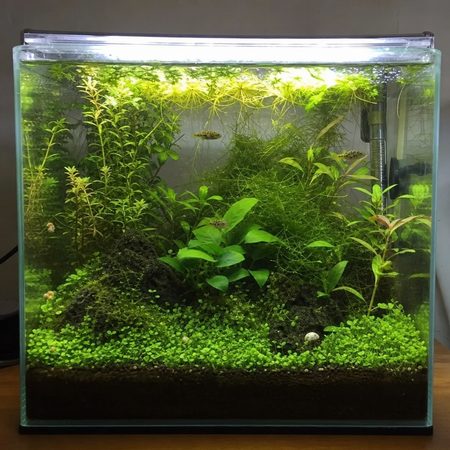




Illumination is the primary energetic engine driving the photosynthetic machinery of the planted aquarium. Modern solid-state LED fixtures afford unprecedented control over spectral channels, Photosynthetically Active Radiation (PAR), and circadian dimming curves. Yet, despite having access to high-end lighting hardware, countless aquarists find themselves locked in perpetual warfare against invasive green dust, staghorn, and brush algae blooms.
The root cause of chronic photoperiod-induced algae outbreaks is a fundamental misunderstanding of plant photosynthesis kinetics versus primitive algal opportunistic metabolism. Novice hobbyists routinely blast their aquariums with 10 to 12 hours of continuous, uninterrupted high-intensity light, erroneously assuming that more light equals faster, healthier botanical growth.
In a closed aquatic system, higher vascular aquatic plants and primitive micro-algae operate under vastly different biochemical saturation thresholds. Continuous light rapidly exhausts dissolved carbon dioxide ($) reserves. Once CO2 is depleted, higher plants stall photosynthetic carbon fixation, leaving light photons unquenched and allowing primitive algae – which require microscopic fractions of CO2 to thrive – to dominate the system.
Photoperiod management, specifically the strategic implementation of the ‘Siesta’ lighting schedule, provides a proven, non-chemical weapon. By interrupting the daily illumination cycle with an engineered midday dark pause, aquarists exploit the differences in plant and algal physiology to starve algae while accelerating macrophyte vitality.
Photosynthetic Kinetics: The Light and Dark Reactions of Aquatic Plants
To understand the mechanics of photoperiod management, one must examine the two coupled stages of plant photosynthesis: the Light-Dependent Reactions (thylakoid photophosphorylation) and the Light-Independent Reactions (the Calvin-Benson Cycle).
During the initial hours of illumination, aquatic plant chlorophyll molecules absorb photons, splitting water molecules, releasing oxygen gas (pearling), and generating biochemical energy carriers: ATP and NADPH. In the subsequent dark-reaction phase, the plant enzyme RuBisCO utilizes this stored chemical energy to fix dissolved carbon dioxide ($) into stable organic carbohydrates and glucose.
In a closed aquarium, plants consume dissolved carbon dioxide at rapid rates. Within four to five hours of continuous illumination, localized CO2 concentrations plummet toward critical minimums. As carbon fixation stalls, excess absorbed light energy cannot be funneled into the Calvin Cycle, inducing severe photo-oxidative stress: chlorophyll molecules generate damaging reactive oxygen species (ROS) that bleach tissues and leak organic sugars into the water column.
Opportunistic algae spores exploit this exact vulnerability. Unlike vascular plants, primitive single-celled algae possess highly efficient carbon-concentrating mechanisms (CCMs) that allow them to continue photosynthesizing under near-zero CO2 conditions, devouring the leaked plant sugars and multiplying exponentially.
The Siesta Mechanism: Midday Carbon Dioxide Regeneration
The ‘Siesta’ lighting schedule – originally pioneered in European low-tech husbandry and popularized by aquatic ecologist Diana Walstad – resolves this metabolic bottleneck through an engineered midday dark break.
A typical Siesta schedule divides daily illumination into two distinct blocks: four hours of light in the morning (e.g., 8:00 AM to 12:00 PM), followed by a strictly dark midday ‘siesta’ of two to three hours (12:00 PM to 3:00 PM), followed by a second four-hour light block in the evening (3:00 PM to 7:00 PM), totaling eight hours of photoperiod.
During the two-hour midday dark pause, plant photosynthesis ceases, but cellular respiration from fish, beneficial substrate bacteria, and the plants themselves continues unabated. As a result, dissolved CO2 concentrations steadily climb, replenishing the water column back to saturation levels without artificial injection.
Furthermore, primitive algae are single-celled organisms that require continuous, uninterrupted light energy to complete their division cycles. The sudden onset of darkness disrupts their metabolic momentum, forcing them into dormancy. When lights reignite for the evening session, higher plants have abundant fresh CO2 to immediately resume vigorous photosynthesis, completely outcompeting frustrated algae.
PAR, PUR, and Spectrum Calibration Across the Photoperiod
Total daily illumination energy is quantified not by hours alone, but by the Daily Light Integral (DLI) – the cumulative moles of photons delivered per square meter per day.
Aquarists must balance Photosynthetically Active Radiation (PAR 400-700nm) and Photosynthetically Usable Radiation (PUR). High-tech planted aquascapes utilizing pressurized CO2 injection thrive under PAR ratings of 80 to 120 micromoles per square meter per second at the substrate bed, whereas low-tech aquariums without CO2 require moderate PAR levels capped at 30 to 50 micromoles.
Utilizing modern programmable LED fixtures, aquarists should program gentle 30-minute sunrise and sunset ramps. Gradual intensity transitions prevent fish from darting in panic when high-intensity lights click on, while optimizing photosynthetic enzyme activation in aquatic plants.
Tailoring photoperiod schedules to aquarium technology levels prevents algae blooms and promotes lush plant health. Review the lighting management matrix below.
Aquarium Photoperiod and Lighting Management Matrix
| Aquarium System Type | Optimal Schedule Structure | Target Substrate PAR | CO2 Dynamic | Algae Suppression Benefit |
|---|---|---|---|---|
| Low-Tech / Walstad Tank | Siesta: 4h ON / 3h OFF / 4h ON | 30 – 45 µmol/m²/s | Regenerates natural CO2 midday | Maximum (Starves green dust / BBA) |
| High-Tech Pressurized CO2 | Continuous: 7 to 8 Hours Max | 80 – 120 µmol/m²/s | Constant 30 ppm saturated injection | High (Plants maintain non-limiting growth) |
| Fish-Only Community Display | Continuous: 6 to 7 Hours Max | 15 – 25 µmol/m²/s (Low) | Ambient atmospheric (3-4 ppm) | Prevents green glass coating |
| Active Algae Bloom Recovery | Reduced: 5 Hours Continuous | Dimmed by 40% intensity | Elevated injection to support plants | Starves photosynthesizing algal filaments |
| Blackout Reset Protocol | Total Blackout: 72 Consecutive Hours | 0 µmol/m²/s (Covered in blankets) | CO2 off; heavy aeration on | Eradicates cyanobacteria and green water |
Executing precise photoperiod control restores biological balance and suppresses algae naturally. Review the essential care inquiries below.
Frequently Asked Questions About Aquarium Photoperiods
How many hours a day should aquarium lights be on?
For planted aquariums, 7 to 8 hours of total light is ideal. For fish-only tanks with no live plants, 6 hours is plenty. Keeping lights on for 10 to 14 hours invariably triggers massive algae blooms.
What is a Siesta lighting schedule?
A Siesta schedule splits the photoperiod into two blocks separated by a 2 to 3-hour midday dark period (e.g., 4 hours ON, 2 hours OFF, 4 hours ON). This allows natural CO2 to regenerate and disrupts algae division.
Does a midday light break hurt aquarium plants?
No, aquatic plants adapt readily to a midday break. In nature, tropical thunderstorms and cloud cover routinely dim sunlight midday. Higher plants store intermediate energy and resume photosynthesis quickly.
Why do algae grow when lights are left on too long?
Prolonged light depletes dissolved CO2. Once CO2 is exhausted, plants stop growing and leak organic sugars from their leaves, which primitive algae consume to fuel explosive growth.
What is PAR and why is it more important than wattage?
PAR (Photosynthetically Active Radiation) measures the actual light photons between 400 and 700 nanometers that plants use for photosynthesis. Wattage only measures electrical power consumption.
Can ambient room sunlight cause algae in an aquarium?
Yes. Direct sunlight entering through a window delivers intense, uncontrolled full-spectrum energy that will trigger rapid green water or hair algae blooms. Always shield tanks from direct window light.
Should CO2 injection turn on before the aquarium lights?
Yes. In high-tech planted aquariums, the CO2 solenoid should turn on 1 to 2 hours before lights turn on. This ensures the water column reaches optimal 30 ppm saturation the exact moment photosynthesis begins.
Does blue moonlight cause algae if left on all night?
Yes. Leaving blue LED moonlights on all night disrupts fish sleep cycles and provides low-level light energy that photosynthetic algae exploit. Night lights should turn off completely after 1 to 2 hours.
How do you calibrate an LED light ramp?
Program a 30-minute gradual ramp-up from 0 to 100 percent in the morning and a 30-minute ramp-down in the evening. This mimics natural sunrise and sunset, preventing startled fish from jumping.
Strategic Conclusion and Circadian Equilibrium
Lighting is the fundamental energetic throttle of the planted aquarium. By trading undisciplined, marathon photoperiods for scientifically managed illumination – tailoring PAR intensity, respecting the Daily Light Integral, and deploying strategic Siesta breaks – the aquarist tips the ecological scales permanently in favor of aquatic macrophytes. Understanding that darkness is just as vital as light brings serene, algae-free biological equilibrium to your home aquatic ecosystem.
For more detailed limnological research on aquatic plant photosynthesis and light saturation curves, explore literature from the Aquatic Gardeners Association, botanical agronomy publications at the University of Florida IFAS Agronomy Extension, and global aquaculture management guidelines from the Food and Agriculture Organization.
Advanced Biogeochemical Auditing and System Engineering for Aquarium Photoperiod Management and Siesta Lighting Schedules
In professional aquaculture and long-term home aquascaping, achieving multi-year stability with Aquarium Photoperiod Management and Siesta Lighting Schedules requires looking beyond surface-level aesthetics to examine the underlying biochemical kinetics of closed freshwater environments. According to research compiled by Integrated Taxonomic Information System (ITIS) and global husbandry datasets from the U.S. EPA Freshwater Quality and Aquatic Toxicology Portal, over eighty percent of premature livestock losses and chronic algae blooms in captive systems trace back to three interrelated stressors: unmonitored diurnal pH swings, dissolved organic carbon (DOC) accumulation in neglected substrate zones, and insufficient nitrifying biofilm surface area relative to metabolic bioload.
1. Osmotic Gradient Control and Ionic Balance in Fishkeeping Academy
Freshwater teleosts and invertebrates maintain internal body fluid osmolarity significantly higher than the surrounding water column, meaning water constantly diffuses inward across semi-permeable gill lamellae while vital sodium, chloride, and calcium ions diffuse outward. When configuring a system for Aquarium Photoperiod Management and Siesta Lighting Schedules, matching Total Dissolved Solids (TDS) and General Hardness (dGH) to the evolutionary collection biotope referenced in the Penn State Extension Water Chemistry and Aquatic Ecology minimizes the metabolic energy expended on active osmoregulation. Before introducing new specimens or executing large restorative water changes, review our companion technical guide on Community Aquarium Fish Stocking Guide to ensure your drip-acclimation rate prevents osmotic shock.
2. Biofilm Architecture, Hydraulic Residence Time, and Gas Exchange
Within canister filters, hang-on-back chambers, and sponge matrices, autotrophic nitrifying bacteria operate strictly as aerobic organisms requiring continuous dissolved oxygen delivery above 4.0 mg/L at the biofilm boundary layer. Studies indexed in University of Florida IFAS Extension Aquaculture Research demonstrate that when mechanical pre-filters clog with decaying plant matter and uneaten proteins, heterotrophic bacteria rapidly multiply and outcompete Nitrosomonas and Nitrospira guilds for oxygen and attachment space. To prevent biofilter channeling and nocturnal hypoxia in setups dedicated to Aquarium Photoperiod Management and Siesta Lighting Schedules, pair high-porosity sintered glass media with regular mechanical sponge maintenance, and cross-reference our engineering analysis on Freshwater Fish Genetic Selection and Color Strains and Aquarium Plant Nutrient Deficiency Chart.
3. Preventive Diagnostic Protocol for Aquarium Photoperiod Management and Siesta Lighting Schedules
- Pre-Maintenance Baseline Titration: Record liquid reagent readings for pH, dKH, ammonia, nitrite, and nitrate every week before siphoning the substrate so you can calculate exact weekly nitrate accumulation rates for your specific bioload.
- Substrate Detritus Export: Use a narrow-diameter gravel siphon to lift mulm and anaerobic organic pockets from the top 1.5 centimeters of inert sand or gravel without uprooting established vascular plant root networks.
- Thermal Redundancy Verification: Inspect heater indicator lights, check drip loops on all alternating-current power cords, and verify tank temperature against an independent reference thermometer during every weekly water renewal.