


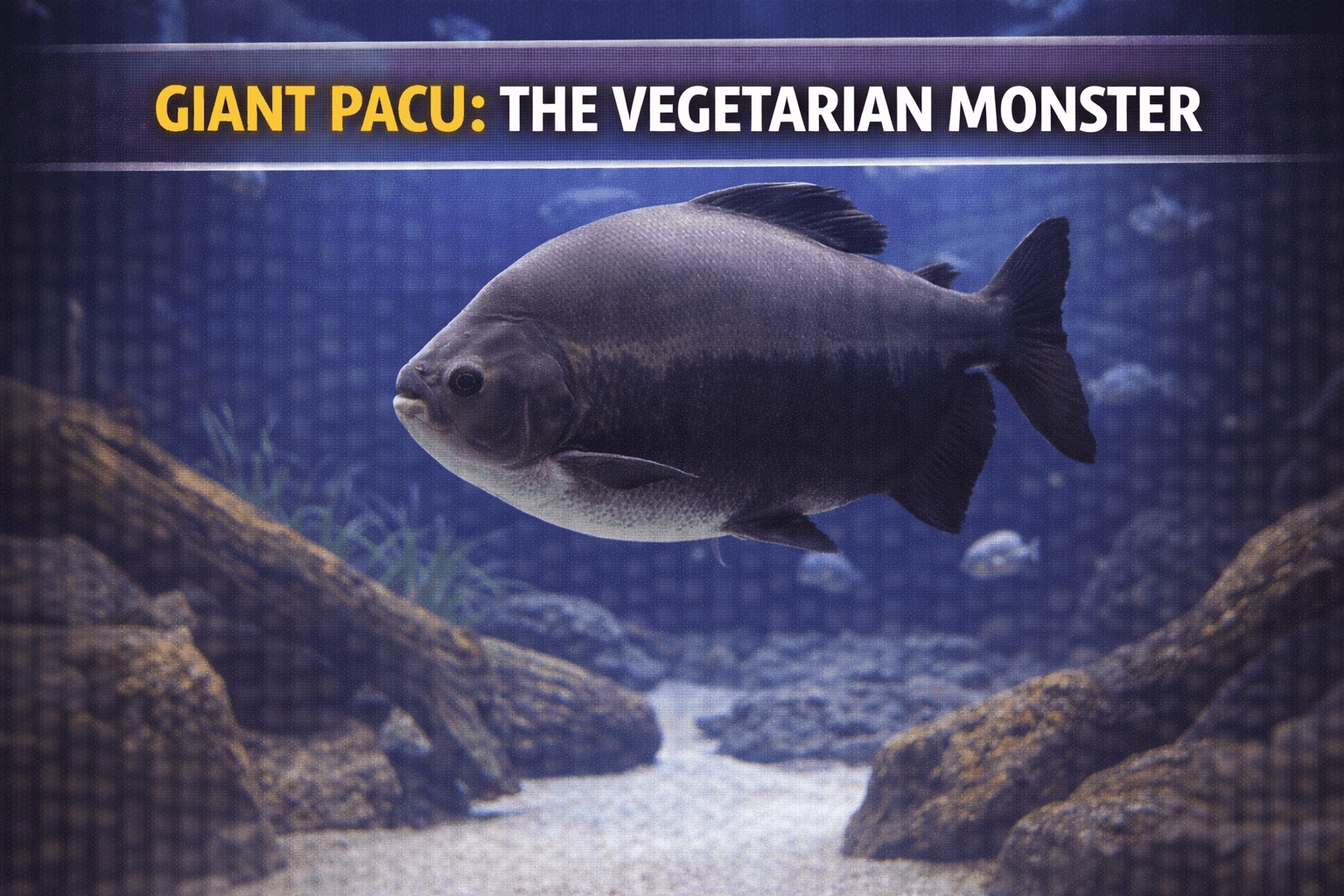
The Piranha That Eats Fruit
If you were walking along the banks of the Amazon River and saw a large, silver, flat fish with a red belly, your first instinct would be to run away. You would think you had found a monster Piranha. I remember the first time I saw a 3-foot Pacu in a large display tank; I was amazed by how much it looked like its famous cousin. But then, the keeper did something strange—they threw a whole apple into the water. Instead of shredding it with razor-sharp teeth, the Pacu crushed it with a mouth that looked surprisingly… human.
The Giant Pacu Scientific Name- (Colossoma macropomum) is one of the most misunderstood giants in the world. While the Piranha is a meat-eater, the Pacu is mostly a vegetarian (an “Herbivore”). They are the “Water Pigs” of the river, spending their days looking for fallen nuts, fruits, and seeds.
In this guide, I am going to help you discover the reality of the Pacu. We will talk about their incredible size, their famous “human” teeth, and the serious technical guidance you need if you ever plan to house this gentle giant.
The “Human” Teeth (The Unknown Factor)
The #1 reason people are eager to discover information about the Pacu is their teeth. Unlike the triangular, sharp teeth of a Piranha, the Pacu has square, flat teeth.

Why do they look like that?
-
The “Nut-Cracker” Design: In the wild, the Pacu eats seeds and nuts that fall from trees into the Amazon. These nuts are very hard. The Pacu needs teeth that can “grind” and “crush” rather than “cut.”
-
The Similarity: To the human eye, they look almost identical to our own back teeth (molars).
-
The Warning Tip: Even though they don’t eat meat, those teeth are powerful. A large Pacu can accidentally crush a finger if it thinks you are holding a piece of fruit! Always use feeding tongs with these giants.
The “Size Shock” (When “Big” is an Understatement)
If you thought the Oscar or the Arowana was big, the Pacu is on a whole different level. This is the most important part of my technical guidance for you.
The Reality of Growth:
-
At the Store: 2 to 3 inches. They are often sold as “Red-Bellied Pacu” and look just like Piranhas.
-
In the Home Tank: They can grow to be 3 to 4 feet long.
-
The Weight: A full-grown Pacu can weigh over 60 pounds.
The Recommendation : Because they grow so fast and so large, I do not recommend the Giant Pacu for home aquariums. They are “Pond Fish” or “Public Aquarium Fish.”
The “Water Pig” Personality
One of the most humanized parts of the Pacu is their personality. They are much calmer and friendlier than Piranhas.
Intelligence and Interaction:
In my research, I have found that Pacus are incredibly smart. They can learn to recognize their owners and will often wiggle their bodies when they see the “person with the fruit” walk into the room.
-
The “Begging” Behavior: They are like puppies. They will follow you back and forth along the glass, waiting for a snack.
-
The “Skittish” Giant: Despite their size, they are very nervous. A loud noise or a sudden light can make a 40-pound Pacu bolt into the glass. At that size, they can easily crack the aquarium glass or hurt their own snouts.
Feeding the Vegetarian Giant
If you are eager to discover how to keep a Pacu healthy, you have to look at your grocery store, not just the pet store.
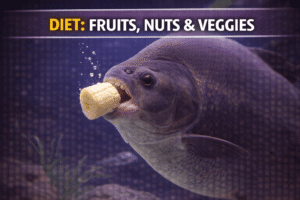
Technical Guidance on Nutrition: Even though they are vegetarians, they need a lot of food. I suggest “Blanching” (boiling for 1 minute) hard vegetables like carrots or broccoli to make them easier for the fish to digest.
-
The “Meat” Exception: Occasionally, a Pacu will eat a bug or a piece of shrimp, but 90% of their diet should be plants.
Technical Guidance on Water and Filtration
A 60-pound fish that eats a lot of fruit is going to create a lot of waste. This is the biggest challenge for any Pacu owner.
-
Filtration: You need a Sump System or a massive industrial-strength canister filter. The waste from a Pacu can turn the water brown and smelly in just a few days if the filter isn’t strong enough.
-
Water Changes: I recommend a 50% water change every week.
-
The “Fruit Mess”: Fruits like bananas or grapes can make the water “cloudy” very fast. I always suggest feeding your Pacu in a specific corner of the tank where you can easily siphon out the extra bits.
Water Parameters:
-
Temperature: 75°F to 82°F.
-
pH: 6.5 to 7.5.
Choosing Tank Mates
Can the Pacu have friends? Yes! They are very peaceful, but their size is a problem for smaller roommates.
Safe Neighbors:
-
Oscars and Arowanas: Since they are all “Monster Fish,” they can live together as long as the tank is massive (500+ gallons).
-
Large Catfish: Like the Red Tail Catfish or large Plecos.
-
Other Pacus: They are very social and love to live in pairs or small groups.
The “Accidental Snack” Warning: A Pacu will not “hunt” other fish, but they are very messy eaters. If a small Neon Tetra gets in the way while the Pacu is lunging for a grape, the Tetra might get swallowed by accident. Always keep them with fish that are at least 6 inches long.
The Ethics of the Pacu
Every year, thousands of baby Pacus are sold for $5 in pet stores. People buy them because they look like Piranhas. But 99% of those fish will die within two years because the owners don’t have the space they need.
The Pacu is a beautiful, intelligent, and funny fish, but it belongs in a public aquarium or a massive backyard pond. If you don’t have a tank the size of a small car, the best way to enjoy a Pacu is to visit them at a local zoo.
3 “Unknown” Facts to Discover About the Pacu
-
They are “Seed Dispersers”: In the Amazon, Pacus are like the “birds” of the water. They eat seeds, swim miles away, and “poop” them out, helping the forest grow new trees!
-
The “Tambaqui”: In South America, the Giant Pacu is called the “Tambaqui.” It is a very important food fish for the local people.
-
They Can Live 30 Years: If you provide a large enough pond, your Pacu could be your companion for three decades. They are a true life-long pet.
Conclusion: Respecting the Water Pig
The Giant Pacu is one of the most unique and interactive fish in the world. With their human-like teeth, their love for fruit, and their “Water Dog” personality, they are a joy to discover.
However, they are also the ultimate “Monster Fish.” They require more space and more cleaning than almost any other fish we have talked about. If you have the resources to build a 1,000-gallon paradise, the Pacu will reward you with a level of friendship you never thought a fish could give.
Do you have a large indoor pond project in mind? Or did you buy a “Red-Bellied” fish and you’re worried it’s a Pacu? Leave a comment below! I am here to provide the resources and guidance you need to make the right choice for your “Big Fish” journey at Aquadolf.