

The Puppy of the Amazon
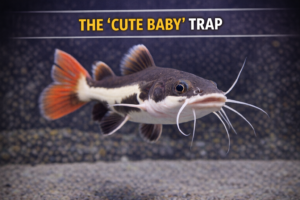
If you walk into a pet store and see a tiny, 3-inch catfish with a bright white belly, a dark back, and a beautiful orange-red tail, you might think you’ve found the perfect pet. They have long, elegant whiskers and a face that looks like it is smiling at you. I remember the first time I saw one in a small display tank; I thought it was the most adorable thing I had ever seen.
In the hobby, we call the Red Tail Catfish Scientific Name- (Phractocephalus hemioliopterus) the “puppy” of the fish world. They are smart, they can learn to eat from your hand, and they are full of personality. But there is a massive “Unknown” factor that many stores won’t tell you: that tiny 3-inch puppy is actually a river monster in disguise.
In this guide, I am going to share the professional technical guidance you need to understand this fish. We will talk about their incredible growth rate, their “vacuum cleaner” mouths, and the reality of what it takes to house a fish that grows to be the size of a human.
The “Size Shock” (A 4-Foot Reality)
Most people are eager to discover how big their fish will get, but with the Red Tail Catfish (RTC), the answer usually shocks them.
The Growth Timeline: I want you to imagine a fish that grows faster than a human baby.
-
At the Store: 3 inches.
-
At 6 Months: 12 inches.
-
At 1 Year: 18 to 24 inches.
-
Full Grown: 4 to 5 feet (48 to 60 inches).
The Weight Factor: It’s not just the length. An adult RTC is thick and incredibly heavy. They can weigh over 80 pounds. I have seen adults that are so large they look more like a shark than a catfish.
-
The Rule: If you do not have the space for a swimming pool in your house, you probably should not buy this fish. It is one of the most “re-homed” fish in the world because owners simply cannot keep up with its size.
The “Home” (Why Glass Tanks Fail)
This is where my technical guidance becomes very serious. A 75-gallon tank, which seems “huge” to a student, is only a temporary home for an RTC.

1. The “Glass Breaker” Warning
By the time an RTC is 2 years old, it is strong enough to break a standard glass aquarium. They are powerful swimmers, and if they get spooked, they can bolt into the side of the tank with enough force to cause a leak or a total break.
2. The Move to the Pond
In my experience, no indoor glass aquarium is truly big enough for a full-grown RTC.
-
The Solution: Most successful RTC owners use Indoor Custom Ponds or large “Stock Tanks” (the big tubs used for cows to drink from).
-
The Minimum Volume: You are looking at 1,000 to 2,000 gallons for a single adult fish. This is why I call them “Monster Fish.”
3. Filtration (The “Tidal Wave” of Waste)
A fish that eats a whole tilapia for lunch is going to produce a massive amount of waste.
-
Technical Guidance: You need industrial-strength filtration. Most keepers use a “Sump System” that is half the size of the tank itself. If the water quality drops even a little, the catfish will develop “Lateral Line Erosion” (holes in its skin).
The “Vacuum” Mouth (Feeding and Tank Mates)
One of the things people love to discover about catfish is their appetite. But with an RTC, this appetite is a danger to every other fish in the tank.
The Mouth Rule: If a fish can fit in a Red Tail Catfish’s mouth, it will be eaten. This catfish is essentially a giant stomach with whiskers. Their mouths can stretch wide enough to swallow fish that are almost half their own size.
-
The Mistake: I have seen people put a “big” Oscar with a “small” RTC, only to wake up the next morning and find the Oscar gone and the RTC looking like a balloon.
The Diet:
-
Carnivore Pellets: For babies, high-protein sinking pellets are best.
-
Fresh Seafood: Adults need whole shrimp, white fish fillets, and earthworms.
-
The “No Mammal” Rule: Never feed your RTC “feeder goldfish” or pieces of chicken/beef. These are too fatty and will cause “Fatty Liver Disease,” which kills the fish.
The “Friendly” Giant Personality
Despite their size and appetite, RTCs are incredibly “human” in their behavior. This is why they are so hard to say “no” to.
Recognizing the “Hand that Feeds”: I have met RTCs that will swim to the surface and let their owners rub their “bellies” like a dog. They have a very high level of intelligence. They will watch you through the glass and can tell when it is “dinner time.”
The “Senses” of a Hunter: Because they live in murky rivers in the wild, their eyesight isn’t great. Instead, they use their Barbels (whiskers). These are highly sensitive organs that feel vibrations and “taste” the water.
-
Tip: Be careful with heaters! An RTC might accidentally “hug” a glass heater with its sensitive skin and get a terrible burn. Always use a heater guard or keep the heater in your filter sump.
Technical Guidance on Water Chemistry
Because they come from the Amazon, they need specific water conditions to thrive.
-
Temperature: 75°F to 80°F. If the water gets too cold, they will stop eating and their immune system will crash.
-
pH: 6.0 to 7.5. They like “neutral” water.
-
The “Ammonia” Emergency: Because they eat so much protein, Ammonia can spike in minutes. I recommend testing the water twice a week for as long as you own the fish.
The “Rescue” Reality
I once visited a large public aquarium that had a “Donation Pond.” Inside were twenty Red Tail Catfish, all of them 3 to 4 feet long.
The keepers told me that every single one of those fish was “donated” by someone who bought it as a “cute baby” in a pet store and realized too late that they couldn’t keep it. Most of these fish end up in terrible conditions because public aquariums are full and cannot take any more.
3 “Unknown” Facts to Discover About the RTC
-
They are Ancient: Fossils of Red Tail Catfish have been found that are millions of years old. They are living dinosaurs!
-
They are Vocal: If you take an RTC out of the water (which you shouldn’t!), they can actually make a “barking” or “croaking” sound by rubbing their bones together.
-
The “Red” Tail: In the wild, the red color on their tail is much brighter. This is often because they eat a lot of small crustaceans (like shrimp) that are full of “carotenoids” (natural color boosters).
Conclusion: Respect the Monster
The Red Tail Catfish is one of the most majestic and “pet-like” fish in the world. They are beautiful, smart, and interactive. But they are not “aquarium fish” in the traditional sense. They are “pond giants.”
If you are a student or a beginner, I hope this guide helps you look past the “cute” face at the pet store. If you truly love the RTC, the best way to show that love is to visit them at a public aquarium or wait until the day you can build a massive pond in your backyard.
Do you have a large setup and you’re wondering if you can handle a monster? Or have you already bought a baby RTC and you’re worried about how fast it’s growing? Leave a comment below! I am here to provide the resources and guidance you need to make the right choice for your home and your fish.