


The Fish That Pet You Back
Imagine walking up to your aquarium and having a fish not just swim toward you, but actually follow your hand, “dance” for your attention, and even let you gently touch its head. I remember the first time I saw a high-quality Flowerhorn in a hobbyist’s home. I reached out toward the glass, and the fish didn’t hide—it flared its fins and wiggled with excitement. It was the first time I realized that a fish could have a personality as big as a golden retriever.
The Flowerhorn Cichlid is a bit of a mystery in the fish world because it doesn’t exist in the wild. It is a “hybrid” created by humans who cross-bred different types of South American cichlids. The result is a vibrant, aggressive, and incredibly smart fish that has taken the hobby by storm.
In this guide, I am going to walk you through the world of the Flowerhorn. We will talk about that famous head bump, why they usually have to live alone, and the technical guidance you need to keep their colors “popping.”
What is That Bump? (The Mystery of the Kok)
The first thing everyone asks when they see a Flowerhorn is: “What is that thing on its head?” In the hobby, we call that bump a “Kok” or a “Nuchal Hump.”
The “Brain” Myth: While it looks like a giant brain, it is actually just a reservoir of soft tissue and fat. In many cultures, a large hump is seen as a symbol of luck and prosperity.
-
Does every Flowerhorn have one? No. Generally, only the males have the large humps.
-
Can you grow it? While good food and clean water help, the size of the bump is mostly determined by the fish’s “genes.” If the father had a big hump, the son likely will too.
The “Flower” Markings: Along the side of the fish, you will see black spots that look like ancient writing or “flowers.” This is where the fish gets its name. High-quality fish have a “flower line” that runs perfectly from the tail all the way to the gills.
The “Lonely King” (Tank Requirements)
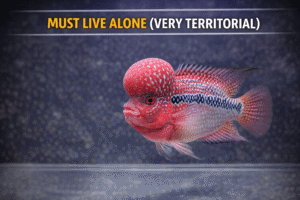
One of the biggest surprises for people eager to discover the Flowerhorn is that they are incredibly territorial.
1. The Individual House
I want to be very clear: A Flowerhorn should almost always live alone. They are “glass-bangers,” meaning they are so aggressive that they will attack and kill almost any other fish you put in the tank.
-
Professional Advice: Don’t feel sorry for them! Flowerhorns don’t get lonely. They view the entire tank as their “kingdom,” and they are much happier when they don’t have to share it.
2. Tank Size
Because these fish can grow to be 12 to 16 inches long and are very thick, you need space.
-
The Minimum: I recommend a 55-gallon tank for a juvenile, but for a full-grown adult, a 75-gallon tank is the goal. Why? They produce a massive amount of waste. In a small tank, the water will become toxic very fast.
3. The “Bare Bottom” vs. Decor
Most pro-keepers keep Flowerhorns in “Bare Bottom” tanks (no sand or gravel).
-
The Reason: Flowerhorns love to dig. They will move gravel around all day, which can scratch the glass. More importantly, it is much easier for you to suck up their waste if there is no gravel.
-
Tip: If you want some decor, use two or three large, smooth stones. Avoid sharp plastic plants, as the Flowerhorn might injure its delicate hump while “charging” at the glass.
The “Tropical Heat” (Water Chemistry)
Flowerhorns are like athletes—they need their environment to be perfect to show their best colors.
1. Keep it Hot Discus and Flowerhorns have one thing in common: they love warm water.
-
The Benefit: Warm water helps their digestion and encourages the growth of the nuchal hump. If the water gets cold (below 76°F), the fish will lose its color and its immune system will weaken.
2. The Filtration Power Because you are feeding high-protein food to a large fish, your filter is the most important piece of equipment.
-
Technical Guidance: I suggest a large Canister Filter or two large Sponge Filters. You want the water to be turned over at least 5 to 10 times per hour.
3. Weekly Water Changes I cannot say this enough: Clean water = A big head. Nitrates are the enemy of the Flowerhorn. I do a 30% to 50% water change every single week. If you let the water stay “dirty,” the head bump will actually shrink.
Feeding for Color and Growth
If you want a “Super Red” fish, you have to feed it like one.
The Menu:
-
Specialty Flowerhorn Pellets: There are many brands (like Okiko or Humpy Head) made specifically to help the bump grow and make the red colors pop.
-
Frozen Treats: They love frozen krill and bloodworms.
-
Fresh Veggies: Sometimes I give mine a blanched pea to help with their digestion.
The “Over-Feeding” Danger: Because Flowerhorns “beg” for food, it is very easy to feed them too much.
-
The Risk: They are prone to “Bloat” and “Hole-in-the-Head” disease.
-
Tip: Feed them twice a day, only what they can eat in 30 seconds. A “lean” Flowerhorn is a healthy Flowerhorn.
Interacting with Your “Water Dog”
This is the part that attracts most people to the website. How do you actually “play” with a fish?
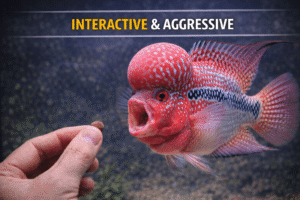
Hand Training: I start by moving my finger along the glass. The Flowerhorn will follow it. Over time, you can lead the fish in circles or loops.
-
The Mirror Trick: Some owners put a mirror in front of the tank for 5 minutes a day. The fish thinks it is a rival and “flares” its fins. This is like a gym workout for the fish; it makes them more aggressive and makes their colors more intense.
-
Warning: Don’t do this for more than 5 minutes, or the fish will get too stressed!
Recognizing the “Vibe”: A Flowerhorn will learn your voice and your face. If I am stressed or moving too fast, my fish can feel it and might hide. If I am calm, he is calm. It is a very deep connection that you won’t find with a school of Neon Tetras.
Technical Guidance: Identifying Quality
If you are eager to discover how to buy a good Flowerhorn, you need to know what “Grade” means.
-
Grade A: These have a massive hump, perfect “flower” markings, and a very round body. They can cost hundreds or even thousands of dollars.
-
Grade B/C: These might have a smaller hump or “broken” flower markings. They are much cheaper and are perfect for a first-time owner.
-
The Eyes: Look for bright, clear eyes. If the eyes are cloudy, the fish has been kept in dirty water.
The Hybrid Ethics
Because Flowerhorns are hybrids, they sometimes have health issues that “wild” fish don’t have. They can have shorter lifespans (usually 8-10 years) and sometimes develop stomach problems.
At Aquadolf, I want you to be a “Compassionate Keeper.” Just because a fish was “made” by humans doesn’t mean it doesn’t deserve the best life possible. If you decide to bring a Flowerhorn into your home, you are promising to be its only friend for its entire life.
3 “Pro” Tips for Flowerhorn Success
-
The Heater Guard: Flowerhorns are very strong and very curious. They will often “attack” the heater in the tank. Always use a plastic Heater Guard so they don’t burn themselves or break the glass.
-
The “White Poop” Check: Keep a close eye on their waste. If the poop is white and stringy, it is a sign of internal parasites. This is very common in Flowerhorns and needs to be treated with medicine like Metronidazole immediately.
-
Stability over pH: While they like a pH of 7.0 to 8.0, they care more about stability. Don’t use chemicals to chase a “perfect” number. Just keep the water clean and the temperature steady.
Conclusion: The Ultimate Pet Fish
The Flowerhorn Cichlid isn’t just a fish; it’s a personality in a box. It is a fish for someone who wants to spend time every day interacting with their pet. They are beautiful, they are “grumpy,” and they are incredibly loyal to the person who feeds them.
If you have the space for a 75-gallon tank and the time for weekly water changes, the Flowerhorn will reward you with years of entertainment. It truly is the fish with a “brain” on its head—and a lot of heart inside.
Are you thinking about getting your first “Kok” fish? Or maybe you’re worried about your Flowerhorn not eating? Leave a comment below! I am here to provide the resources and guidance you need to become a successful “Monster Fish” keeper.