

The “Clear Water” Trap
I want to tell you about a mistake I made. I saved up my money, bought a beautiful 10-gallon tank, and went to the store. I bought the gravel, the plants, and five bright orange Guppies. Set it all up, and put the fish in right away. The water looked crystal clear. I thought I was a genius!
But three days later, my fish stopped eating. They sat at the bottom of the tank, and their gills looked red and sore. By the end of the week, I had lost all of them. I was heartbroken. I thought, “Maybe the water was dirty?” But it looked perfectly clear!
That was the day I learned the most important rule in the hobby: Clear water is not always healthy water. There are “invisible poisons” that build up in a new tank. “Cycling” is the process of growing “Good Germs” that eat those poisons. In this guide, I’m going to show you exactly how to do this so you never have to feel the heartbreak that I did.
Phase 1: What is “The Cycle”? (The City Analogy)
To understand the Nitrogen Cycle, I want you to imagine your aquarium is a tiny city. Your fish are the people living in that city.
Every city produces waste (trash and sewage). If a city doesn’t have a trash crew to pick up the garbage, the streets get dirty and people get sick. Your aquarium is the same. Fish produce waste every time they eat or breathe. This waste turns into a chemical called Ammonia.
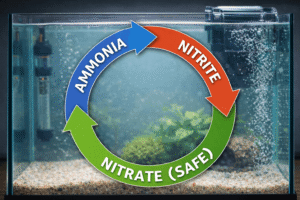
The Three Levels of the Cycle:
-
Ammonia (The Poison): This is the “trash” in your city. It is very dangerous. It burns a fish’s skin and makes it hard for them to breathe.
-
Nitrites (The Middle Man): Eventually, a group of “Good Germs” will move into your filter and start eating the Ammonia. They turn it into Nitrites. This is better, but Nitrites are still poisonous to fish.
-
Nitrates (The Safe Stuff): Finally, a second group of “Good Germs” appears and eats the Nitrites. They turn them into Nitrates. These are much safer!
“Cycling” your tank simply means waiting for these two groups of “Good Germs” to grow in your filter so they can act as your city’s trash crew.
Phase 2: Why I Never Recommend a “Fish-In” Cycle
In many pet stores, they will tell you to buy a “hardy” fish (like a Danio) and put it in a new tank to start the cycle. I strongly disagree with this advice.
When you do a “Fish-In” cycle, you are making that fish live in Ammonia (poison) for weeks. It is painful for the fish, and it often leads to a shorter life. At Aquadolf, I teach the “Fish-Less” Cycle. We grow the “Good Germs” before we buy the fish. It takes more patience, but it is the kindest and most successful way to start.
Phase 3: The Step-by-Step Fish-Less Cycle Guide
This process usually takes 3 to 6 weeks. I know that feels like a long time to wait for an empty tank, but trust me—it is worth it. Use this time to finish your schoolwork or plan your aqua scaping!
Step 1: The Setup
Set up your tank exactly how you want it. Add your gravel, your filter, and your heater. Fill it with water and always use a water conditioner (like Seachem Prime) to remove the chlorine from your tap water.
-
Tip: Keep your filter running 24 hours a day. The “Good Germs” need the moving water to stay alive.
Step 2: The “Ghost” Feeding
Since there are no fish in the tank, there is no “poop” to make Ammonia. We have to provide “food” for the germs to start growing.
-
What I do: Every day, I drop a tiny pinch of fish food into the empty tank. As that food rots, it creates Ammonia. This tells the “Good Germs” that there is food for them, so they start to move into your filter.
Step 3: The Waiting Game
For the first two weeks, you won’t see anything happening. The water might even get a little cloudy. Don’t panic! This is a sign that the germs are growing.
-
Tip Secret: I turn my heater up to 82 degrees during the cycle. Germs grow faster in warm water! Just remember to turn it back down to 78 before you add fish later.
Step 4: Testing the Water
You cannot “see” the Nitrogen Cycle with your eyes. You need a “Liquid Test Kit.”
-
I recommend the API Master Test Kit. It looks like a little science lab with glass tubes and colorful drops. It is much more accurate than the “paper strips” you see at the store.
Phase 4: How to Know When You Are Finished
You will know your tank is “Cycled” when your test kit shows these three things:
-
Ammonia is 0: The first crew of germs is doing its job.
-
Nitrite is 0: The second crew of germs is finished.
-
Nitrate is 5 to 20: This shows that the cycle is complete!
Once you see 0 Ammonia and 0 Nitrite, your “city” is safe. You are ready to go to the store and pick out your first fish!
The Mentor’s Secret: How to Speed Up the Cycle
I know you are excited to get fish. If you don’t want to wait 6 weeks, there are two “expert hacks” I use to cut the time in half.
1. The “Dirty Sponge” Trick
Bacteria (Good Germs) don’t appear out of thin air. If you have a friend who has a healthy, old fish tank, ask them for a piece of their “dirty” filter sponge. Squeeze that brown “gunk” into your new filter.
-
Why it works: That “gunk” is actually millions of live germs. You are essentially “teleporting” a finished trash crew into your new city. This can make your tank ready in just 1 or 2 weeks!
2. Bottled Bacteria
You can buy products like Seachem Stability or FritzZyme 7. These are bottles full of live “Good Germs.” I find that they work best if you add them every day for the first week.
3 Things That Can “Crash” Your Cycle
Even after your tank is cycled, you can accidentally kill your “Good Germs” if you aren’t careful. I see beginners do this all the time, and it causes their fish to get sick.
1. Rinsing the Filter in the Sink
Tap water has chlorine. Chlorine is meant to kill bacteria so we can drink the water safely. If you wash your filter sponge under the sink, you will kill all your “Good Germs.”
-
What I do: I only rinse my filter in a bucket of old tank water. It stays “dirty,” but the germs stay alive!
2. Replacing the Filter Cartridge
The box at the store will tell you to throw away your filter cartridge every month. Please don’t do this! That cartridge is where your “Good Germs” live. If you throw it away, you are throwing away your cycle. I keep my sponges until they are literally falling apart.
3. The Power Outage
If your power goes out and the filter stops moving for more than a few hours, the germs can die because they don’t have oxygen.
The Day I “Over-Cleaned”
I once had a 20-gallon tank that was perfect for two years. One day, I decided it looked “too dirty,” so I took out all the gravel and washed it with hot water and soap. I even scrubbed the filter until it was white again.
I was so wrong. Within two days, all my fish were gasping at the top. I had killed my “Invisible Heartbeat.” I had to start the whole cycle from zero while my fish were suffering. I felt terrible. It taught me that a “clean-looking” tank is not always a “healthy” tank. A little bit of brown gunk in the filter is a sign of a job well done!
Phase 5: Adding Your First Fish
Once your tank is cycled, follow these three final rules:
-
Rule 1: The Big Water Change. Before you add fish, your “Nitrate” levels will be very high. Do a big 50% water change to make the water fresh.
-
Rule 2: Don’t Buy Everything at Once. Start with 2 or 3 fish. Let the germs adjust to the new waste for a week before you add more.
-
Rule 3: Keep Testing. For the first week, I test the water every day to make sure the Ammonia stays at zero.
Conclusion: You are Now an Aquarist!
The Nitrogen Cycle is the difference between a “fish owner” and an “aquarist.” Most people just buy fish and hope for the best. But you have taken the time to understand how nature works. You have built a “city” for your fish and hired a “cleanup crew” to keep them safe.
I am so proud of you for being patient. I know it’s hard to look at an empty tank for a month, but your fish will thank you by living a long, happy, and colorful life. You have built a strong foundation for your aquarium, and now the real fun begins!
If you are currently cycling your tank and your test kit is showing strange colors, leave a comment! I love talking about water chemistry and I am here to help you get through the “waiting game.”