

The Gentle Giant of Africa
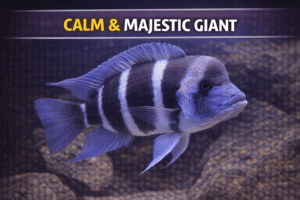
First time I saw a colony of Frontosas in a 200-gallon tank. I was used to the high-speed chasing of most African Cichlids, but these fish were different. They didn’t zip around; they glided. With their deep blue fins and bold black stripes, they looked like a row of underwater zebras moving in slow motion. I sat there for an hour just watching them, and I realized that these were not just fish—they were a living work of art.
The Cyphotilapia Frontosa (and its cousin, the Gibberosa) comes from Lake Tanganyika in Africa. This is one of the oldest and deepest lakes in the world. Because they live in deep water (sometimes 100 feet down!), they have a very calm personality. They are the “Thinkers” of the cichlid world.
In this guide, I am going to share my professional experience with these “Kings.” We will talk about their unique “Colony” life, the importance of hard water, and why you need a very deep tank to make them feel at home.
The “Hump” of Wisdom
The first thing people eager to discover the Frontosa notice is the large bump on their forehead. In the hobby, we call this the Nuchal Hump.
Why do they have it?
-
The Maturity Sign: Both males and females can have the hump, but it is much larger on the males. It is a sign of age and status. A male with a massive hump is the “King” of his colony.
-
The “Unknown” Factor: Scientists still aren’t 100% sure what the hump does, but in a home tank, it makes the fish look very powerful and wise.
The Blue Shimmer: The most attractive part of the Frontosa is the blue color on their fins and face. In some varieties, like the “Blue Zaire,” the blue is so dark it looks like glowing neon. As your mentor, I can tell you that keeping that blue bright requires very specific water conditions.
The “Palace” (Tank Requirements)
Because Frontosas grow to be 12 to 14 inches long and live in large groups, you cannot keep them in a standard beginner tank.
1. Tank Size (The “Length” Rule)
A Frontosa is a long-lived fish (up to 20 years), and they grow slowly but steadily.
-
Recommendation: At least a 75-gallon tank for a small group, but for a real colony, a 125-gallon or 150-gallon tank is the professional standard.
-
The Depth Factor: Since they are deep-water fish, they prefer a tank that is “tall” as well as “long.” This gives them the vertical space they are used to in the African lake.
2. The Rockwork (Building a Reef)
In Lake Tanganyika, Frontosas live among large rocks and sandy floors.
-
Technical Guidance: You should use large, smooth rocks to create caves. However, don’t fill the whole tank with rocks like you would for other African cichlids. Frontosas are large and can be clumsy; they need plenty of open sand to swim without bumping into sharp edges.
3. Substrate (The Sand Preference)
I always use Fine Sand (like pool filter sand or aragonite) for my Frontosa tanks.
-
Why? They love to sift through the sand. Also, a dark or blue sand can make their blue colors look much more intense!
The Magic of “Hard Water”
This is the part where many students get confused, but I will make it simple for you. Lake Tanganyika has very special water—it is very “Hard” and has a high pH.

The “Chemistry” Guidance:
-
pH Level: You should aim for 8.0 to 9.0. If the pH is too low (like 7.0), the fish will lose their color and become stressed.
-
Hardness: They need minerals like calcium and magnesium.
-
The Trick: I use Crushed Coral or Aragonite as my substrate. These slowly dissolve into the water, keeping the pH high and the water “hard” naturally. You won’t have to use as many chemicals!
Temperature: Keep the tank between 76°F and 80°F. They like it slightly cooler than some other tropical fish because deep lake water doesn’t get very hot.
Living in a Colony (The Social Rule)
This is the most important part of the “Frontosa Secret.” You should never keep a Frontosa alone.
The 1-to-5 Rule: In my experience, the best way to keep these fish is in a “Colony.”
-
The Group: I suggest one male and at least four or five females. * Why? If you have two males, they will fight for the “King” spot. If you have only one female, the male will annoy her too much. A group of females keeps the male calm and makes the whole tank peaceful.
The “Gentle” Temperament: Unlike other cichlids that bite and chase, Frontosas are usually very calm. They might “push” each other, but they rarely cause injuries. This makes them a great “Big Fish” for people who don’t want a “Monster” that destroys everything.
Step 5: Feeding the King
Frontosas are predators. In the wild, they wait for smaller fish to go to sleep and then eat them.
The Professional Menu:
-
High-Protein Sinking Pellets: This should be their main food.
-
Frozen Foods: They love Mysis shrimp, Krill, and Bloodworms.
-
The “Air” Warning: I have seen Frontosas get “bloat” because they gulp air at the surface while eating floating flakes. Always use sinking food so they stay at the bottom and don’t swallow air.
The Feeding Time: I feed my colony twice a day. Since they are slow-moving, make sure the “faster” fish in the tank don’t steal all the food before the Frontosas get a chance!
Choosing Tank Mates
Because they are slow and calm, you cannot put them with “mean” fish like Oscars or fast “nippers” like Tiger Barbs.
Good Neighbors:
-
Other Tanganyika Cichlids: Like Altolamprologus compressiceps or Leleupi. They share the same water needs.
-
Large Synodontis Catfish: These “Cuckoo” catfish look great with Frontosas and help clean the sand.
-
Plecos: A large Bristlenose or Rubber-lip Pleco is safe.
The “Mouth” Warning: Even though they are “Gentle,” they are still predators. Any fish small enough to fit in a Frontosa’s mouth (like a Neon Tetra) will disappear at night. Always choose tank mates that are at least 3 inches long.
Maintenance and Stability
The biggest enemy of a Frontosa is change. They love stability.
-
Water Changes: I do a 20% water change every week. I am very careful to make sure the “new” water has the same temperature and pH as the “old” water. If the pH jumps around, the Frontosa might get “Cloudy Eye.”
-
Filtration: Use a large Canister Filter. Frontosas produce a fair amount of waste, and they need the water to be very clean to stay blue.
-
The “Spook” Factor: Because they live in deep, quiet water, they are easily scared by loud noises. I suggest putting their tank in a quiet corner of your room, not next to a door that slams.
The “Zen” of the Frontosa
When I have a stressful day, I don’t go to my Oscar tank (because they are too crazy) or my Guppy tank (because they move too fast). I go to my Frontosa colony.
There is something about their slow movement and their “wise” eyes that makes me feel calm. They are the “Zen Masters” of the aquarium. If you are a student who needs a relaxing environment to study in, a Frontosa tank is like a living meditation. They don’t demand your attention; they just exist with beauty and grace.
3 “Unknown” Facts to Discover About Frontosas
-
They Can Live 20 Years: This is not a “short-term” pet. Your Frontosa could be with you from the time you start school until the time you buy your first house!
-
They Are Nocturnal Hunters: In the wild, they hunt at dawn and dusk. Their large eyes are designed to see in very low light.
-
The “Blue Zaire” Mystery: The deepest-living Frontosas are the bluest. Collectors have to bring them up to the surface very slowly (sometimes over several days) so they don’t get “the bends” from the pressure change!
Conclusion: Is the King Right for You?
The Cyphotilapia Frontosa is the ultimate fish for the “sophisticated” hobbyist. They are not for people who want action and fighting; they are for people who want beauty, calmness, and a sense of history.
If you have the space for a 125-gallon tank and the patience to keep your water “Hard” and “Clean,” the Frontosa will reward you like no other fish. They will become the “Royalty” of your home, gliding through their rockwork with a dignity that is truly king-like.
Are you ready to build a kingdom for a Frontosa? Or are you worried that your tap water is too “soft” for them? Leave a comment below! I am here to provide the resources and guidance you need to succeed with the Deep-Water King at Aquadolf.